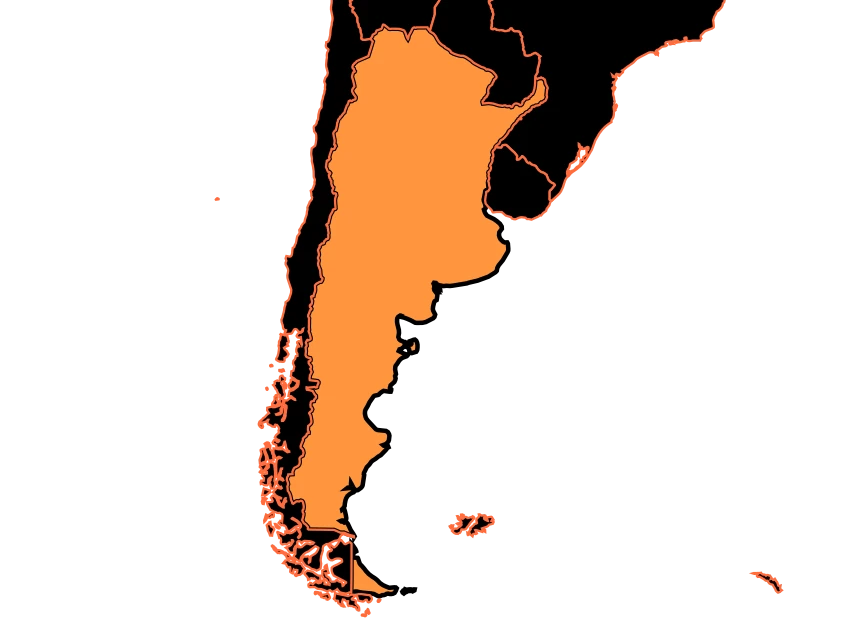



FalKland Islands
The Falkland Islands, an archipelago located in the South Atlantic, about 480 kilometers off the coast of Argentina, comprise two main islands, West Falkland and East Falkland, along with a large number of smaller islands. Geographically, they lie on the South American continental shelf, with a cold and windy climate and topography ranging from rolling hills to rugged coasts. Their strategic location makes them a key point for maritime control of the South Atlantic and access to Antarctica.
History of the Falkland Islands
The history of the Falkland Islands is complex and marked by the sovereignty dispute between Argentina and the United Kingdom. The islands were first sighted in the early 16th century, possibly by Spanish or Portuguese navigators. In 1690, English Captain John Strong made the first recorded landing on the islands, naming them the Falkland Islands in honor of the Viscount Falkland, First Lord of the Admiralty. Later, France established a colony on East Falkland in 1764, which was then sold to Spain in 1767. Spain maintained a garrison on the islands until 1811, when it abandoned them because of the wars of independence in South America.
In 1820, Argentina, after gaining independence from Spain, declared its sovereignty over the Falkland Islands, considering them an integral part of its territory inherited from the Spanish crown. In 1829, it appointed a governor for the islands, but in 1833, the United Kingdom occupied the islands and expelled the Argentine population, establishing a British administration that has remained to this day. Argentina has never recognized the British occupation and has continuously claimed sovereignty over the islands, arguing that the occupation was an illegitimate act of force.
The Sovereignty Dispute
The sovereignty dispute over the Falkland Islands is based on different interpretations of history and international law. Argentina argues that it inherited Spain’s rights over the islands, while the United Kingdom maintains that the 1833 occupation and the principle of self-determination for the islanders give them the right to keep their current status as a British Overseas Territory. United Nations General Assembly Resolution 2065, adopted in 1965, urges Argentina and the United Kingdom to negotiate a peaceful solution to the dispute, taking into account the interests of the islanders.
In 1982, tensions between Argentina and the United Kingdom escalated into the Falklands War. The conflict was triggered when Argentine forces invaded the islands in April 1982. The United Kingdom responded with a naval and military force that retook the islands in June 1982. The war resulted in the deaths of hundreds of soldiers and marked a turning point in relations between the two countries. Despite the military defeat, Argentina continued to claim sovereignty over the islands through diplomatic means.
Current Situation
Today, the Falkland Islands are a British Overseas Territory with their own government and constitution. The inhabitants of the islands, known as kelpers, are mostly descended from British settlers and are entitled to British citizenship. The islands’ economy is based mainly on fishing, sheep farming, and tourism. The United Kingdom maintains a military base on the islands for their defense.
Argentina continues to claim sovereignty over the Falkland Islands and considers the British presence to be an illegitimate occupation. The Argentine government has urged the United Kingdom to negotiate a solution to the dispute, but the United Kingdom has refused to do so without the consent of the islanders, who expressed their desire to remain British in a referendum held in 2013. The sovereignty dispute remains a recurring issue in relations between Argentina and the United Kingdom, and although there is no active armed conflict, the sovereignty question persists as an obstacle to a closer relationship between the two countries.
The international community is divided on the issue of sovereignty over the Falkland Islands. Some countries, mainly in Latin America, support Argentina’s claim, while others, such as the United States and most European Union countries, maintain a neutral position or support the United Kingdom’s right to sovereignty over the islands. The Falkland Islands dispute remains a complex and sensitive issue that requires a peaceful, negotiated solution that takes into account the interests and wishes of all parties involved.