

Meet: Non La of Steel
That’s how Vietnam would be if it was a superhero:
Non La of Steel

Population:
102.177.431,00 inhab
Pop. Growth:
9,54 %
Area:
310.070,00 km2
Density:
328,00 hab/km2
Wealth:
4.717,30 $/person
Literacy:
96,13 %
Largest city:
Ho Chi Minh - 14,052,713 inhab
Urban population:
41,40 %
Life expectancy:
75,05 years
Average age:
33,90 years
Highest peak:
Fansipan - 3,143 m
Largest river:
Mekong - 4,350 km
Rainfall:
1.821,00 mm/m2
What are the defining characteristics of Vietnam?
The country of Non La of Steel

Rice fields
Rice fields have profoundly shaped the landscape, cuisine, and rural life of Vietnam. Rice cultivation sustains traditions, communities, and an ancestral relationship with the land and water.
Architecture

Street food
Street food is part of everyday Vietnamese life, with small stalls and informal restaurants. Eating out is a social and gastronomic experience deeply integrated into urban life.
Cuisine
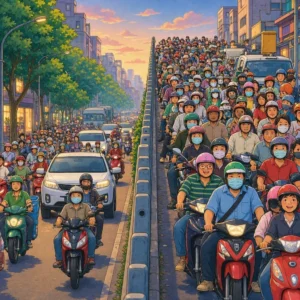
Motorcycles
Motorbikes dominate daily mobility in Vietnamese cities. Their enormous presence on the streets reflects urban dynamism and is one of the most characteristic images of contemporary Vietnam.
Culture
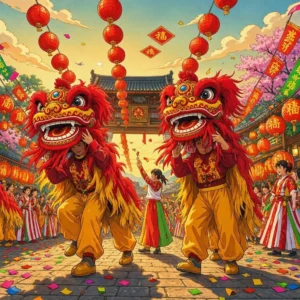
Tet
The Vietnamese New Year is the most important family celebration of the year. It brings generations together, honors ancestors, and combines food, traditions, family gatherings, gifts, and renewal.
Culture
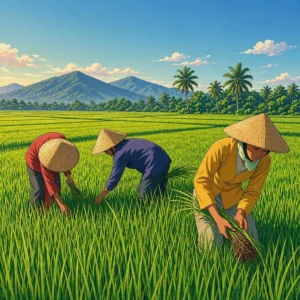
Nón lá
The iconic Vietnamese conical hat is historically linked to rural work and protection from the sun and rain. Today it remains one of the country's visual symbols.
History

Áo dài
The elegant traditional Vietnamese dress combines tradition, beauty, and cultural pride. It is worn especially at celebrations, ceremonies, and important occasions, becoming a recognizable symbol of Vietnamese identity.
Culture
Vietnam: featured
The file of Non La of Steel tells us...
Vietnam
Official language(s): Vietnamese
Currency: Dong
Government: One-party system
Main religion: Traditional Vietnamese
Demonym: Vietnamese
Hanoi
Hab. 5,764,980
Hanoi means ‘between two rivers’, as it is situated between the Red River and the Black River. This ancient city offers a fascinating blend of history and modernity. Explore the Old Quarter, visit Hoan Kiem Lake and soak up the rich local culture in its temples and markets. A must-see destination in the heart of Asia.
Ho Chi Minh
Hab. 14,052,713
Before the Vietnam War (between North and South Vietnam), Ho Chi Minh City was known as Saigon. Following the North’s victory over the South, the southern capital was renamed after the Northern leader. Ho Chi Minh City is a major metropolis and the industrial and economic heart of Vietnam, home to large multinational companies, particularly in the textile and technology sectors.
Can Tho
Hab. 2,071,270
Can Tho is the largest city in the Mekong Delta. Although it is an inland port, it is of such importance that it has become a major commercial hub in the country. Can Tho is protected by dykes against the Mekong’s annual floods.
Hoi An
Hab. 32,757
Hoi An is a coastal town in central Vietnam whose architecture reflects a blend of different periods in Vietnamese history: French colonial, Chinese, traditional Vietnamese houses, a Japanese bridge, temples, and so on.
Mekong
The Mekong Delta in Vietnam is a vast, fertile region where the Mekong River branches into numerous channels and tributaries before flowing into the South China Sea. During the Vietnam War, it was the scene of intense fighting due to its strategic and agricultural importance and because the Viet Cong used it for guerrilla warfare.
Annamite Range
The Annamite Range, the backbone of Vietnam, is a mountain range that stretches along the border with Laos and Cambodia. Historically, it has served as a natural barrier, influencing the distribution of populations and trade routes. Geographically, it features a diversity of ecosystems, ranging from tropical rainforests to rugged peaks.
Red River
The Red River in Vietnam is a vital waterway that flows through the north of the country. Its name refers to the reddish colour of its sediment-laden waters. Historically, it has been of vital importance to agriculture and transport, as well as being the cradle of Vietnamese civilisation.
Neighbouring countries
Superheroes who help each other
We haven’t studied these countries yet: Cambodia, China and Laos.
Come back in a few weeks and they might already be here.
Superhero stories
Interesting facts about Vietnam




To take away
Would you like a hard copy?
One Vietnam worksheet, ready to print. You print it, curiosity does the rest.