

The Coliseum
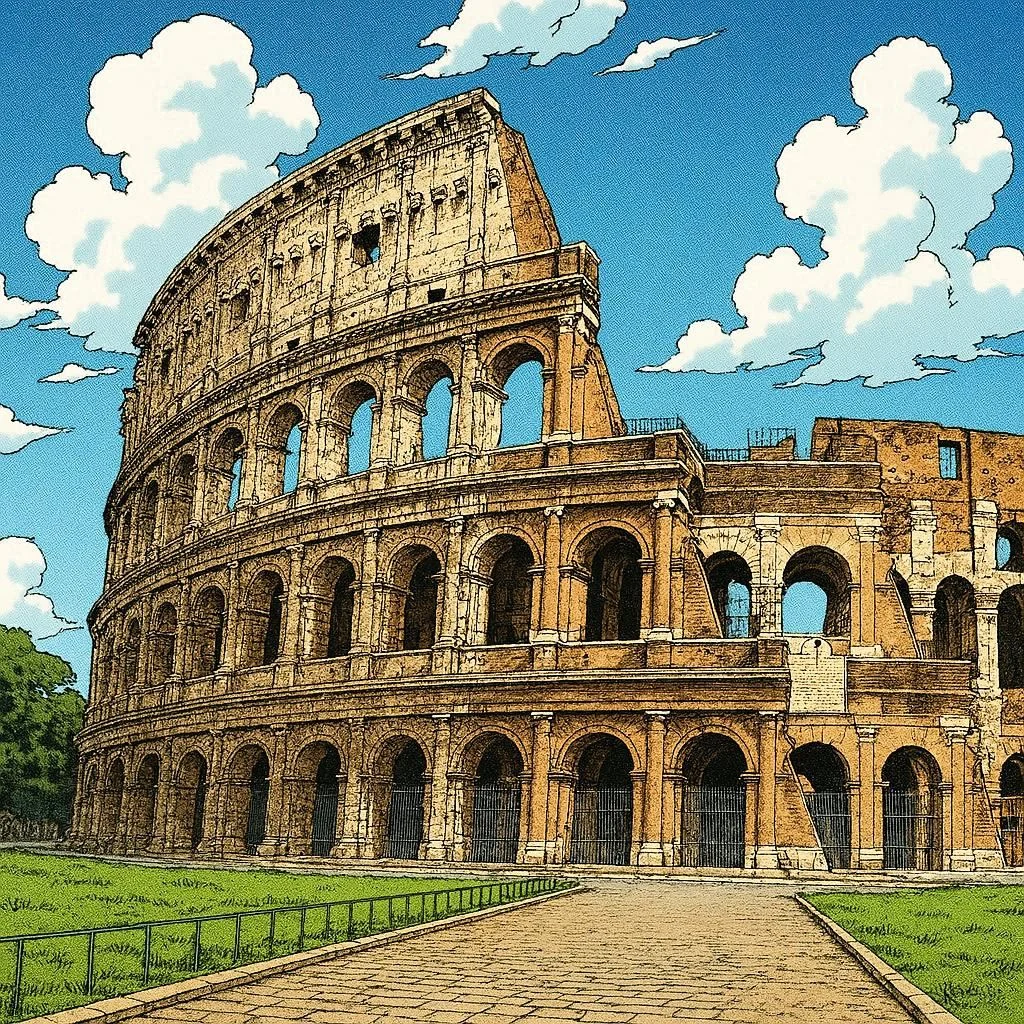
The Roman Colosseum, originally known as the Flavian Amphitheater, rises majestically in the heart of Rome, Italy, a lasting testament to the architectural ingenuity and grandeur of the Roman Empire. Its geographical location is strategic, set in a valley between the Palatine, Esquiline, and Caelian hills, an area that had traditionally been used for public spectacles. The design of the Colosseum, a perfect ellipse, allowed optimal visibility from any point in its tiers, accommodating tens of thousands of spectators. Its construction, begun by Emperor Vespasian in 72 AD and completed by his son Titus in 80 AD, was a monumental project that employed thousands of workers and used materials innovative for their time, such as Roman concrete, which proved to be incredibly durable. The central arena, a rectangular space covered with sand (hence its name derived from the Latin “arena”), was the main stage for events, while the complex network of underground tunnels and cages, known as the hypogeum, allowed for the surprise ظهور of gladiators and animals.
The Roman Colosseum: The home of the gladiators
This stone colossus was not only an engineering feat, but also the epicenter of Rome’s social and political life for centuries. Its main purpose was to entertain the Roman people through massive and often bloody public spectacles. The most famous events included gladiatorial fights, in which trained men fought one another or against wild beasts, often to the death. Exotic animal hunts (venationes) were also held, in which creatures brought from the far reaches of the empire were displayed and hunted, as were public executions. These spectacles, funded by the emperor and the Roman elite, served to maintain the regime’s popularity and distract the masses from social and political problems, following the famous motto of “bread and circuses.” The audience, divided by social class, occupied specific seats in the tiers, reflecting the strict hierarchy of Roman society. The roar of the crowd, the shouts of the fighters, and the growl of the beasts echoed through this vast arena, creating an atmosphere of excitement and terror that defined the Colosseum experience.
The Roman Colosseum after the Roman Empire
The history of the Colosseum is as fascinating as its architecture. After the fall of the Western Roman Empire, the amphitheater gradually fell into disuse and suffered the effects of time and natural disasters, such as earthquakes. However, far from being abandoned, its fate evolved. During the Middle Ages, it was used as a fortress, as a quarry for obtaining building materials for other structures in Rome, and even as a place of worship, with the construction of a small church inside it. It was only in the 18th and 19th centuries that a process of conservation and restoration began, driven by the Vatican and various governments, aimed at preserving this icon of Roman history. The scale of the challenges faced by Roman engineers and architects, the sophistication of their construction techniques, and the durability of the materials they used are truly astonishing. It is estimated that 100,000 cubic meters of travertine were needed for its construction, transported from the quarries of Tivoli, and that the work took only eight years to complete, a monumental achievement considering the technology available.
The ability to hold more than 50,000 spectators and to design an evacuation system so efficient that it could empty the venue in a matter of minutes is another of the aspects that demonstrate its brilliance.
The Colosseum as a Wonder of the World
The Colosseum is, without a doubt, one of the wonders of the ancient world and endures as a universal symbol of Roman engineering, architecture, and culture. Its legacy goes beyond the mere physical structure; it represents the ambition, power, and organization of a civilization that left an indelible mark on the history of humanity. Despite its often brutal past, the Colosseum offers us a unique window into the complexities of Roman society, its values, its spectacles, and its way of life. Its imposing presence today, even in ruins, evokes the grandeur of an empire and the human capacity to create monumental works that defy time. The preservation of the Colosseum is a global responsibility, a duty to future generations so that they may contemplate and learn from this incomparable remnant of our collective past. It teaches us about humanity’s destructive capacity, but also about its undeniable creative ability and its yearning for transcendence, characteristics that, throughout history, have inspired countless works of art, literature, and architecture.