

Ceuta & Melilla
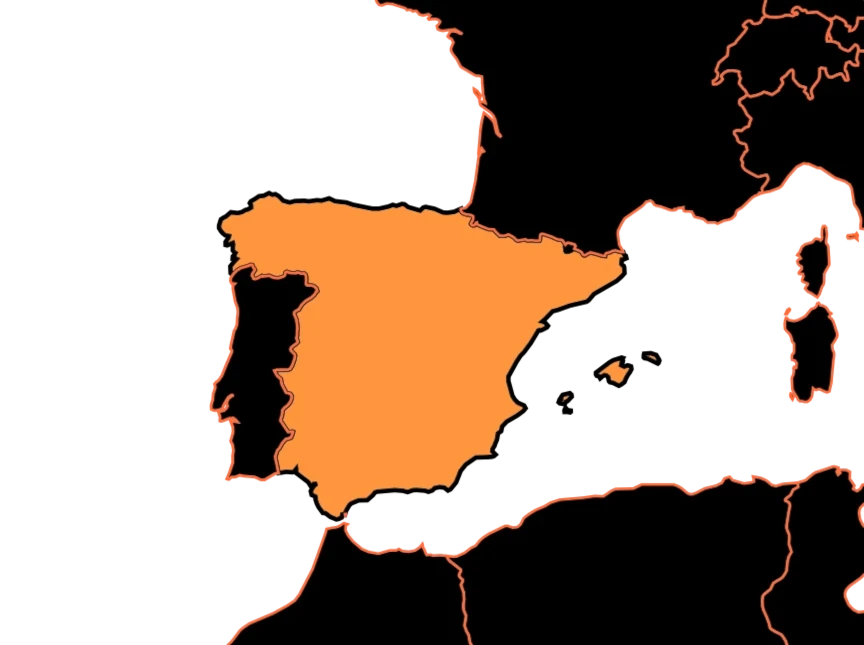
Ceuta and Melilla, two Spanish autonomous cities located on the northern coast of Africa, represent a strategic enclave and a meeting point between cultures. Their geographical and historical uniqueness makes them territories of great interest, but also a focal point of geopolitical tensions.
Geography of Ceuta and Melilla: Europe’s Gates in Africa
Ceuta, with an area of 18.5 km², is located on the Almina Peninsula, opposite the coast of the Iberian Peninsula, in the Strait of Gibraltar. Melilla, for its part, covers an area of 12.3 km² and is located on Cape of the Three Forks, bordering Morocco. Both cities enjoy a Mediterranean climate, with warm, dry summers and mild, humid winters. Their terrain is rugged, with elevations that dominate the landscape and offer panoramic views of the Mediterranean and the African continent.
The strategic location of Ceuta and Melilla makes them important centers of trade and transit between Europe and Africa. Their ports are key points for maritime traffic and the exchange of goods, while their land borders represent the European Union’s only land border with an African country.
History: A Legacy of Conquest and Reconquest
The history of Ceuta and Melilla dates back to antiquity, when they were colonized by Phoenicians, Carthaginians, and Romans. After the fall of the Roman Empire, they came under Visigothic and Byzantine rule before being conquered by the Arabs in the 8th century. During the Middle Ages, they were the subject of disputes between different kingdoms and dynasties, until they were finally incorporated into the Crown of Castile. Ceuta was conquered by Portugal in 1415 and passed to Spain in 1668, while Melilla was taken by Spain in 1497.
Since then, Ceuta and Melilla have remained under Spanish sovereignty, despite Morocco’s attempts to claim them. Their history has been marked by coexistence among different cultures and religions, as well as by the defense of their identity in the face of external pressure.
The Dispute with Morocco: An Unresolved Territorial Conflict
The main reason there is a dispute between Spain and Morocco regarding Ceuta and Melilla is that Morocco considers both cities to be occupied territories and claims sovereignty over them. Morocco bases its claim on historical, geographical, and cultural arguments, asserting that Ceuta and Melilla were part of the former Kingdom of Morocco and that their population is mostly of Moroccan origin.
Spain, for its part, defends its sovereignty over Ceuta and Melilla on the basis of the principle of territorial integrity and the fact that both cities have belonged to Spain for centuries. Spain argues that the population of Ceuta and Melilla is mostly Spanish and that both cities are integrated into Spain’s political, economic, and social system.
The dispute over Ceuta and Melilla is a recurring issue in relations between Spain and Morocco. Although both countries have maintained regular dialogue on the matter, no definitive solution has been reached. The situation is further complicated by the presence of irregular migrants attempting to enter Ceuta and Melilla from Morocco, as well as by the drug trafficking and smuggling activities taking place in the area.
Current Situation: Challenges and Opportunities
Today, Ceuta and Melilla are Spanish autonomous cities with a special status. They have their own governments and parliaments, which have authority in various areas such as education, healthcare, urban planning, and tourism. However, they depend on the central government of Spain for defense, foreign affairs, and security.
Ceuta and Melilla face various challenges, such as unemployment, irregular immigration, lack of infrastructure, and economic dependence on Spain. However, they also have important opportunities, such as their strategic location, their cultural heritage, their tourism potential, and their role as a bridge between Europe and Africa.
To overcome the challenges and take advantage of the opportunities, Ceuta and Melilla need to diversify their economy, promote sustainable tourism, improve their infrastructure, and strengthen their ties with Europe and Africa. It is also essential for Spain and Morocco to continue dialoguing to find a peaceful and lasting solution to the dispute over the sovereignty of Ceuta and Melilla.
In short, Ceuta and Melilla are two unique and exceptional cities, with a rich history, a strategic location, and an uncertain future. Their fate will depend on the ability of their inhabitants and their leaders to overcome the challenges and seize the opportunities before them.