

Menhirs of Carnac
The stone army
Imagine going for a walk in a field and discovering that thousands of giant stones are arranged in rows, one behind the other, as if an army had frozen in place thousands of years ago. Some reach your waist; others are so tall that you would have to tilt your head way back to see the top. There is no castle, no walls, and no signs explaining who put them there. And the most incredible thing is that many were already standing there before the pyramids of Egypt were built.
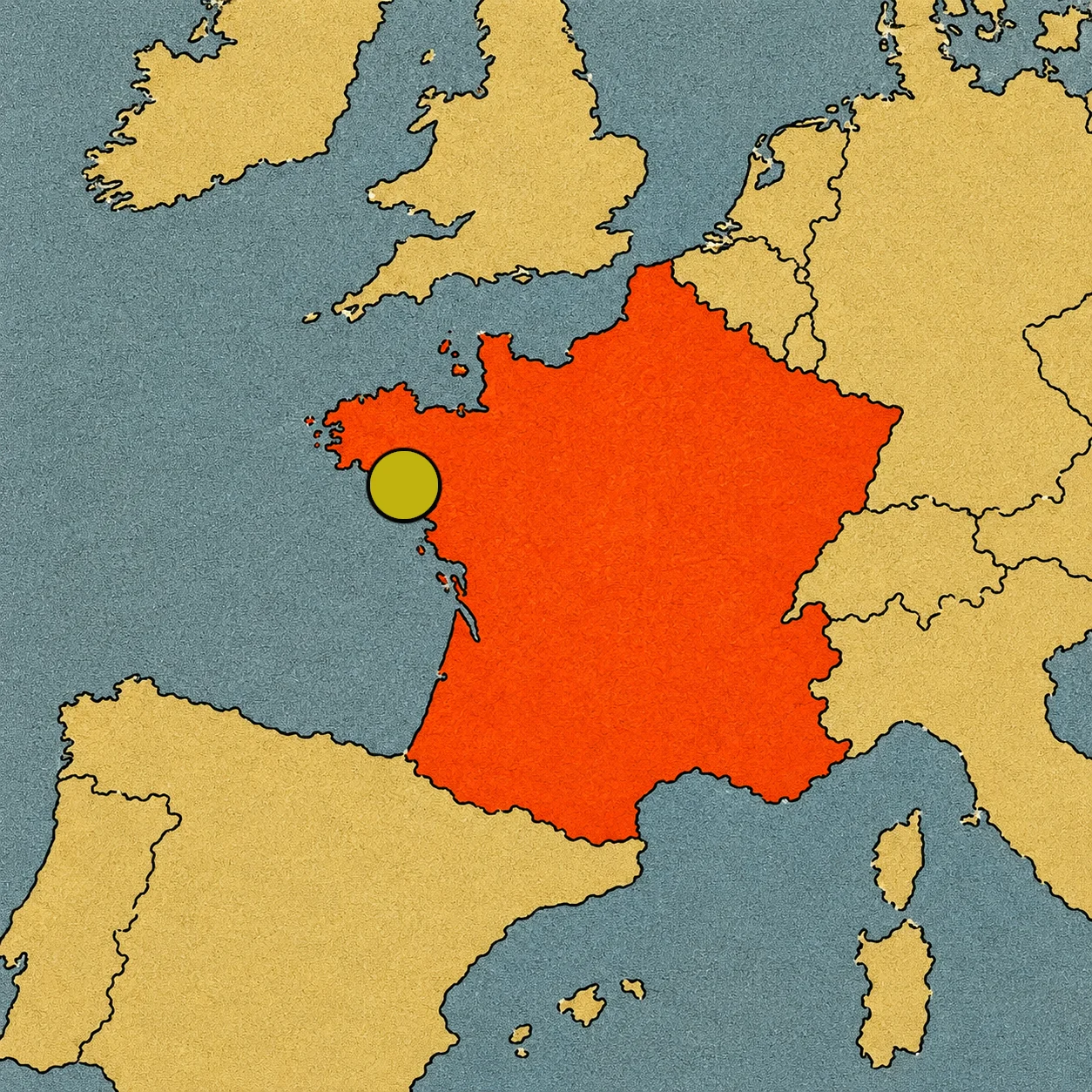
Welcome to Carnac, in the French region of Brittany. Here, prehistoric communities raised a stone landscape that still baffles archaeologists. How did they move those blocks without trucks or cranes? Why did they place them in long rows? We know quite a bit about when they were built, but some of the most interesting questions remain open.[1]
A place full of giants
Carnac is in northwestern France, in a region of green fields, small hills, and a coastline dotted with bays and islands. The Atlantic Ocean is nearby, and water has been part of the landscape for thousands of years.
It was here that Neolithic communities—the era when many societies began to live by farming and raising livestock—built enormous monuments. The structures were made little by little, over a very long period: roughly between 5000 and 2300 BC. That means there wasn’t a single group of people who arrived one day and set all the stones in place. Different generations transformed the territory over the course of more than two millennia.
Some raised menhirs; others built stone tombs, mounds, and circles. The result was a monumental landscape that connected different places and structures.[1]
Rows that vanish into the horizon
The stones of Carnac stretch for nearly four kilometers. In total, it is estimated that there are around 3,000 menhirs in these alignments. That is an awful lot of blocks to put up without modern tools!
If you walk through the site, you will see that the stones are not all the same: some are tall and narrow, others shorter and wider, and some look tilted. Nor do they form perfect lines like on graph paper. The rows adapt to the terrain and are part of a design much more complex than it first appears.[2]
And there is an important detail: not all the stones we see today are necessarily in their original positions. Some disappeared, others broke, and others were moved or reused over the centuries.
Because of this, studying Carnac is a bit like putting together a puzzle with missing pieces. Archaeologists compare the alignments, study the soil, and look for remains of ancient structures to understand what the landscape was like when the monuments were raised. Every stone provides a clue, though not always a clear answer.
The army divided into groups
The best-known groups are Le Ménec, Kermario, and Kerlescan:
– Le Ménec: this is one of the most famous complexes. Its menhirs form long parallel rows that stretch across the land and, at one end, meet an enclosure of stones arranged in a circle. When you see it, it gives the impression that the rows are marching in an orderly way toward that circular space.
– Kermario: stands out for its long rows of stones and some especially tall menhirs. The stones vary in size: some are relatively short, while others rise several meters above the ground. That difference makes the whole layout look like a formation stretching all the way to the horizon.
– Kerlescan: features another grouping of parallel rows, more compact than the image people usually think of when picturing Carnac. At one of its ends, there is an enclosure made of standing stones. The layout has a unique shape and allows us to compare how the builders organized the blocks in different sectors of the landscape. [3]
How did they move such massive boulders?
Try to imagine the challenge. You have a huge rock and you want to take it to a field a good distance away. You can’t load it onto a truck or call a crane. What do you do?
The inhabitants of Carnac didn’t have engines, but they did have ropes, wood, tools, and practical knowledge. They might have dragged some stones on wooden sleds or prepared the ground to make moving them easier. Tree trunks could have served as rollers in certain situations, although we don’t know for sure which method was used for each block.
After moving the stone, the trickiest part was still left: standing it up and getting it to stay firm. To do this, they probably dug a hole, placed the block inside, and packed the space around its base.
We don’t know how many people took part in each operation or how long it took. Nor is there a recipe explaining how every single menhir was raised. But one thing is clear: having brute strength wasn’t enough. They had to plan, coordinate the workers, and know their materials well. Those communities were able to organize projects that required time and shared effort. The giant stones didn’t appear there by accident: behind them were decisions, skills, and people who knew how to work together.[1]
The big mystery: what were they for?
This is the question that turns Carnac into a real detective investigation. The stones are there, but they didn’t leave behind an instruction manual. We don’t have a written text by their builders saying, “We put them up to celebrate this ceremony” or “These rows mark the edge of our territory.”
Archaeologists have proposed different explanations. Perhaps some stones marked important places; maybe the alignments were used in ceremonies or were connected to the beliefs of those communities. They also study how some monuments are visually linked to others and how they relate to the terrain and water streams. Even so, there is no single proven explanation that solves the mystery of the entire complex.[3]
That doesn’t mean researchers are working in the dark. They can measure the stones, analyze archaeological remains, study carvings, and compare monuments from different places. The hard part is figuring out what they meant to the people who built them. The exact same stone could have had a different meaning for different generations, and not all monuments had to serve the same function.
The mystery of Carnac doesn’t need aliens or magic to be fascinating: it’s enough to think that we are trying to understand the ideas of people who lived more than five thousand years ago.
Menhirs, tombs, and legends
A menhir is a large stone placed in a vertical position. The word comes from Breton, a language from Brittany, and combines terms related to “stone” and “long.” But Carnac is not just made of isolated stones or rows. The surrounding area also features dolmens—structures made with large slabs that can form burial chambers—and tumuli, which are mounds that sometimes cover tombs.
Some stones still have carvings, as if their builders wanted to leave signs on the rock. Those marks also help researchers study the symbolic world of Neolithic communities.[1]
Over time, the site inspired extraordinary stories. A local legend says that the menhirs were Roman soldiers turned to stone by Saint Cornelius. What a great way to explain an unmoving army!
But archaeology tells a different story: the stones were raised thousands of years before the Romans ever arrived in the region. Legends tell us how people from later eras tried to understand those stone giants; archaeological remains help us investigate who actually built them.[2]
Long before castles
When we think of France’s history, we sometimes imagine medieval castles, kings, and knights. Carnac forces us to go back much further than that. Its earliest monuments were raised at a time when communities already farmed plants, raised animals, and built settlements, but the big cities of antiquity did not exist yet.
The people who lived here knew the materials of their environment and left a massive footprint on the landscape. We don’t know what they were called or exactly what language they spoke, and we cannot attribute their monuments to Celtic druids either: those groups belong to a later era.
The builders of Carnac were prehistoric communities with their own customs, knowledge, and beliefs. Their history shows that monumental architecture began long before the great empires we usually study in books ever existed.[1]
A wonder with global protection
For centuries, the stones inspired legends and sparked travelers’ curiosity. Later on, researchers began studying them using archaeological methods, and authorities pushed for measures to preserve them. On July 12, 2025, UNESCO inscribed the complex known as the “Megalithic Monuments of Carnac and the Shores of Morbihan” onto the World Heritage List. [1]
Today, preserving Carnac means protecting the stones, but also the landscape that helps us understand how they related to one another. Visitor foot traffic, vegetation, and wear and tear can affect such an ancient place. That is why it is important to respect the paths and guidelines when you visit. That way, people who arrive a hundred years from now will still be able to gaze at those rows and ask the very same questions.
In the end, the stone army doesn’t need to move to tell an extraordinary story. Every menhir reminds us that, thousands of years ago, some people decided to transform their world and left clues that we are still trying to understand. We might never discover all their reasons. But we can keep investigating how they raised the stones, what relationship they had with the landscape, and what they meant to the people who placed them there. And that is the true wonder of Carnac: a real-life mystery, built by human hands, that has survived for millennia.
Sources
- UNESCO: timeline, monument types, and relationship with the landscape — https://whc.unesco.org/es/list/1725/
- Centre des Monuments Nationaux: approximate dimensions and description of the alignments — https://www.monuments-nationaux.fr/en/content/download/9830003/file/CMN_SALES_GUIDE_GB_2026.pdf
- French Ministry of Culture: possible interpretations of the menhirs — https://archeologie.culture.gouv.fr/megalithes/en/menhirs