
French Revolution
The revolution that crossed borders
Imagine having to pay more and more for bread, your family going hungry, and meanwhile, some people enjoying huge privileges just for being born into a powerful family. Plus, if you want to change the rules, you barely have a voice. Would you think that’s fair?
In France, in the late 18th century, thousands of people began asking themselves similar questions. And they didn’t just complain: they took to the streets, defied the king, and changed the course of history.
The French Revolution began in 1789 and deeply transformed the country. It questioned the absolute power of the monarchy, attacked the privileges of the nobility and the clergy, and spread an idea that would cross oceans: people could claim rights and participate in political decisions. But the revolution was also marked by conflict, fear, and violence. It was a story of great hopes, difficult decisions, and contradictions that still make us think.[1]
A country full of inequalities
To understand why the revolution broke out, we have to travel to the France of Louis XVI. Society was traditionally divided into three estates: the clergy, the nobility, and the third estate. The first two enjoyed major privileges. The third brought together the vast majority of the population: peasants, artisans, merchants, workers, and the bourgeoisie.
And who paid a large part of the taxes? Precisely many of the people who had the least political power. While some noble families lived surrounded by luxury, numerous peasants had to hand over part of their harvests and face other burdens. In the cities, the price of bread could become an urgent problem: if the staple food cost too much, a family could run out of money for other needs.
The kingdom was also going through a severe financial crisis, worsened by state debts and expenses. Bad harvests and rising food prices made the situation worse. There was not a single cause for the revolution: economic problems, social inequalities, political conflicts, and new ideas about freedom and power all mixed together. More and more people questioned whether the king could rule without limits and whether privileges should depend on birth.[1]
1789: when protests turn into a revolution
In May 1789, Louis XVI summoned the Estates-General, a meeting of representatives from the three estates, to find a way out of the crisis. But a decisive question soon arose: how should they vote? The third estate represented the majority of the population, but feared that the nobility and clergy could impose their decisions.
In June, these representatives of the third estate proclaimed themselves the National Assembly. They wanted to draft a Constitution that would limit the monarch’s power. On June 20, finding the meeting hall locked, the deputies moved to a tennis court and swore not to separate until they had given France a Constitution. That episode went down in history as the Tennis Court Oath.[2]
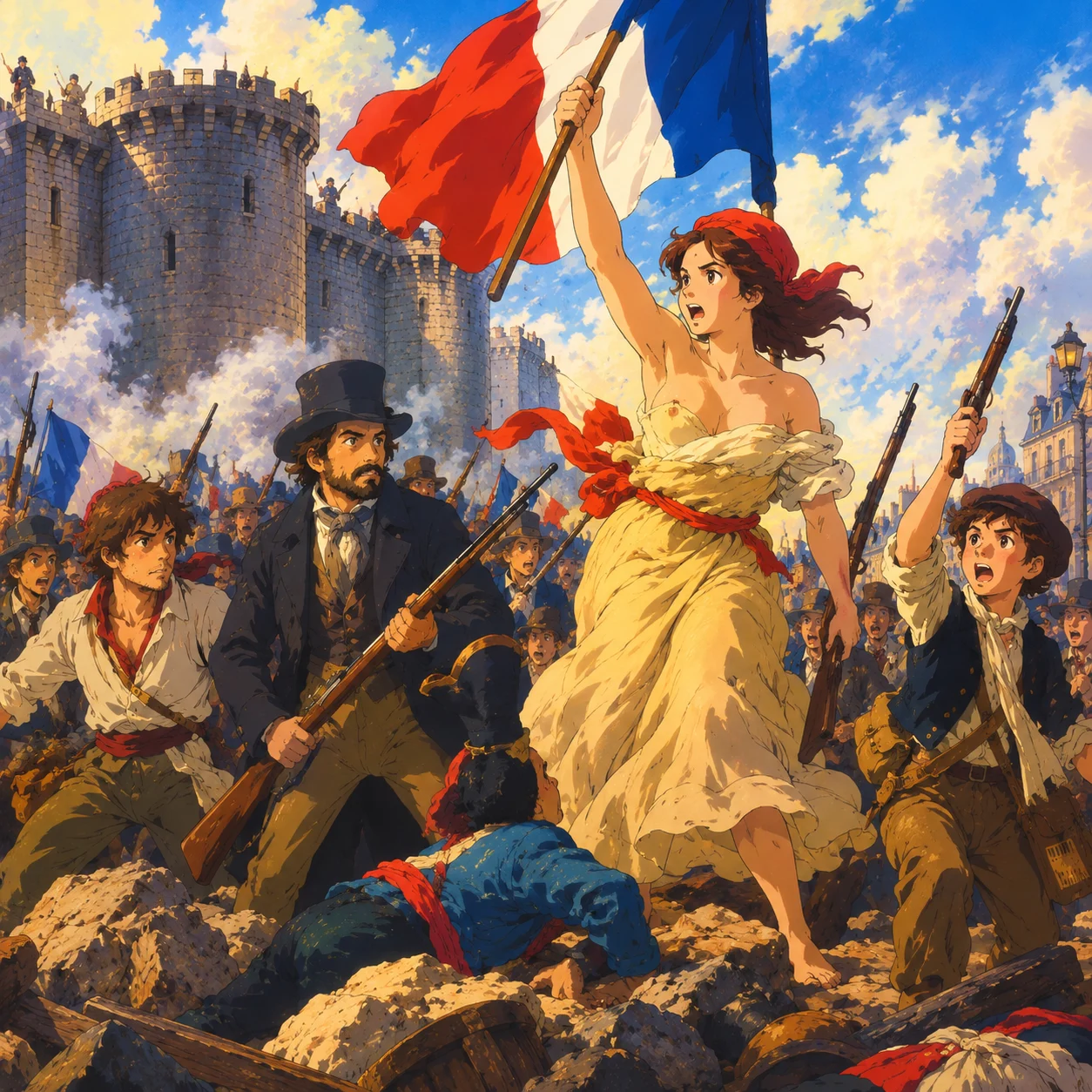
Tension increased during the summer. On July 14, 1789, a crowd of Parisians stormed the Bastille, a fortress that also served as a royal prison and armory. They were looking for weapons and gunpowder, but the meaning of the event was much greater: the population had defied a symbol of the king’s power.
The news spread across France and beyond its borders. July 14 eventually became the French national holiday. However, the revolution was not made in a single day. Protests, political disputes, and revolts in the countryside continued. In August, the Assembly abolished numerous feudal privileges and approved the Declaration of the Rights of Man and of the Citizen.[1][2]
Liberty, equality, and fraternity
The Declaration of the Rights of Man and of the Citizen, approved on August 26, 1789, was one of the great symbols of the revolution. It defended powerful ideas for the time: liberty, equality before the law, security, and the right to resist oppression. It also stated that sovereignty belonged to the nation, not solely to the king.[3]
Put simply, power should no longer be justified just because a person was born into a royal family. Laws and government had to respond to common principles. These ideas were connected to the Enlightenment, an intellectual movement that encouraged critical thinking, questioning authority, and using reason to improve society.
But there was an uncomfortable question: who was actually included in that equality?
For everyone?
Although the document spoke of universal rights, women did not gain the same political rights as men. In 1791, the writer and activist Olympe de Gouges published the Declaration of the Rights of Woman and of the Female Citizen. She demanded that women also be able to participate in political life, hold public office, and enjoy equality before the law. Her proposal was not accepted, and she would end up executed in 1793, during the most violent stage of the revolution.[4]
The contradiction didn’t end there. France also had colonies where thousands of people were enslaved. How could anyone talk about freedom while keeping other people deprived of it? That question would travel to the Caribbean and have extraordinary consequences.
From king to republic
The revolution did not follow a smooth path. In October 1789, a crowd, which included many women worried about the price and shortage of bread, marched to Versailles and forced the royal family to move to Paris. The king remained on the throne, but his authority was increasingly limited.
In 1791, a Constitution was approved establishing a constitutional monarchy: the king still existed, although he had to share power with representative institutions. However, trust had worn thin, especially after Louis XVI tried to flee the country and was caught in Varennes.
In 1792, as France went to war with other European monarchies, the crisis deepened even further. In August, revolutionaries stormed the Tuileries Palace, and the monarchy fell. On September 22 of that year, the republic was proclaimed: France would no longer have a king as head of state.[5]
The change was massive. But it also opened up a dangerous debate: how to defend the revolution against those who wanted to stop it? Some revolutionaries feared that foreign armies and internal enemies would destroy everything that had been achieved. Others mistrusted their own comrades. Arguments grew harsher, and politics sometimes started to become a struggle for survival.
When the revolution turned against its own ideals
In January 1793, Louis XVI was put on trial and executed by guillotine. In October of the same year, his wife, Marie Antoinette, was also executed. For supporters of the republic, the death of the king symbolized a definitive break with the monarchy. For his opponents, it showed just how far revolutionary violence could go.[6]
Between 1793 and 1794, the period known as the Terror took place. The revolutionary government took exceptional measures in a context of war, economic crisis, and internal clashes. Thousands of people were executed after being accused of acting against the revolution, and many others died in episodes of violence and repression. Suspicion could turn into a constant threat.
One of the best-known figures of this stage was Maximilien Robespierre, a revolutionary leader who defended harsh measures to protect the republic. However, in July 1794, his political enemies managed to arrest him, and he was executed. The Terror lost its grip, although France continued to go through years of instability.[7]
This period reminds us of something important: fighting in the name of freedom does not guarantee that every decision will be fair. A revolution can start by demanding rights and end up persecuting those who think differently. That is why studying this period is not just about celebrating a historical change, but also about asking ourselves how rights are protected when a society is divided and afraid.
A revolution that crossed the ocean
While France experienced its transformations, its colonies were also shaken by the ideas of liberty and equality. In Saint-Domingue, a French colony in the Caribbean whose wealth depended heavily on plantations and the labor of enslaved people, a major insurrection began in 1791. Its participants fought against a system that treated them as other people’s property.
The rebellion turned into a long revolution that included wars, shifting alliances, and clashes against French forces. Among its leaders, Toussaint Louverture stood out, playing an essential role in the struggle for emancipation. In 1804, after years of war, the former colony declared its independence and adopted the name Haiti.[8]
Revolutionary ideas also circulated through Europe and America, influencing debates on sovereignty, constitutions, and rights. That does not mean all subsequent revolutions were the same or had a single cause. Each society had its own history. However, the events in France helped spread questions that could no longer be ignored: who should rule?, where does their authority come from?, what rights does a person have simply by virtue of being human?[3][8]
And what happened next?
The French Revolution is usually dated between 1789 and 1799. During those ten years, France went from an absolute monarchy to a constitutional monarchy, then to a republic, and finally to a government increasingly concentrated in the hands of its leaders. In November 1799, Napoleon Bonaparte seized power in a coup d’état. Years later, he would become emperor.
That didn’t mean all the transformations vanished. The old society of privileges had been deeply questioned, and ideas about citizenship, equality before the law, and national sovereignty continued to influence politics. Some of those ideas were captured in later constitutions and declarations of rights.[3][5]
Nor did the revolution immediately solve all inequalities. Women’s rights remained limited, slavery and colonialism continued to shape lives and territories, and the path toward broader political participation would be a long one. Historical changes rarely end when a new law is proclaimed: rights need to be recognized, protected, and truly put into practice.
An echo we still hear
The French Revolution was not a perfect adventure where everything went right. There was bravery, hope, and new ideas, but also violence, exclusions, and broken promises. Exactly for that reason, it remains so important to study.
When we talk today about equality before the law, citizen participation, or the limits of political power, we keep running into questions that occupied the revolutionaries of 1789. Their answers did not solve every problem, but they changed the conversation in France and far beyond its borders.
The big lesson is perhaps this: demanding freedom is only the beginning. A society must also decide how to protect it for everyone, even for those who think differently. The revolution opened a door that could no longer be easily closed, and later generations kept arguing about what should be on the other side.
Sources
- National Assembly of France: causes and chronology of the French Revolution — https://www.assemblee-nationale.fr/dyn/histoire-et-patrimoine/revolution-francaise
- Parcours Révolution Paris: chronology of the events of 1789 — https://parcoursrevolution.paris.fr/es/cronologia
- Presidency of France: Declaration of the Rights of Man and of the Citizen — https://www.elysee.fr/en/french-presidency/the-declaration-of-the-rights-of-man-and-of-the-citizen
- National Assembly of France: Olympe de Gouges and the Declaration of the Rights of Woman and of the Female Citizen — https://www.assemblee-nationale.fr/dyn/histoire-et-patrimoine/revolution-francaise/declaration-des-droits-de-la-femme-et-de-la-citoyenne-olympe-de-gouges
- National Assembly of France: from the Estates-General to the National Assembly — https://www2.assemblee-nationale.fr/15/evenements/2019/la-revolution-s-affiche/des-etats-generaux-a-l-assemblee-nationale-juin-1789-octobre-1791
- National Assembly of France: trial and execution of Louis XVI — https://www.assemblee-nationale.fr/dyn/histoire-et-patrimoine/revolution-francaise/proces-et-execution-de-louis-xvi
- National Assembly of France: the period of the Terror — https://www.assemblee-nationale.fr/dyn/histoire-et-patrimoine/revolution-francaise
- Library of Congress of the United States: Haiti and the Haitian Revolution — https://guides.loc.gov/francophone-caribbean-collections-library-of-congress/haiti