
Dune of Pilat
The moving mountain of sand
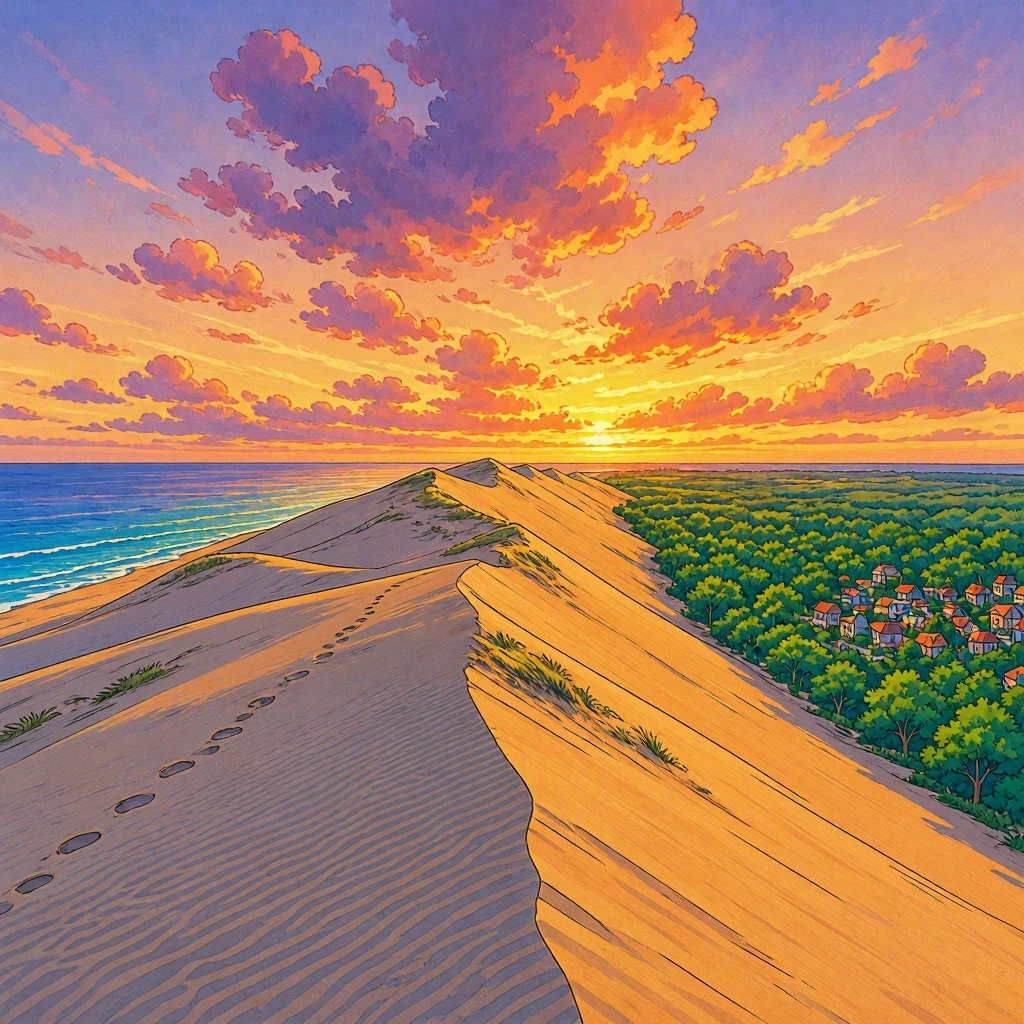
Imagine climbing a mountain without finding any rocks, grass, or snow beneath your feet. Just sand—millions and millions of grains that slide away every time you take a step. On one side you have the Atlantic Ocean; on the other, an immense pine forest. And the most surprising thing is that this mountain isn’t still: it moves slowly and is gradually covering the forest!
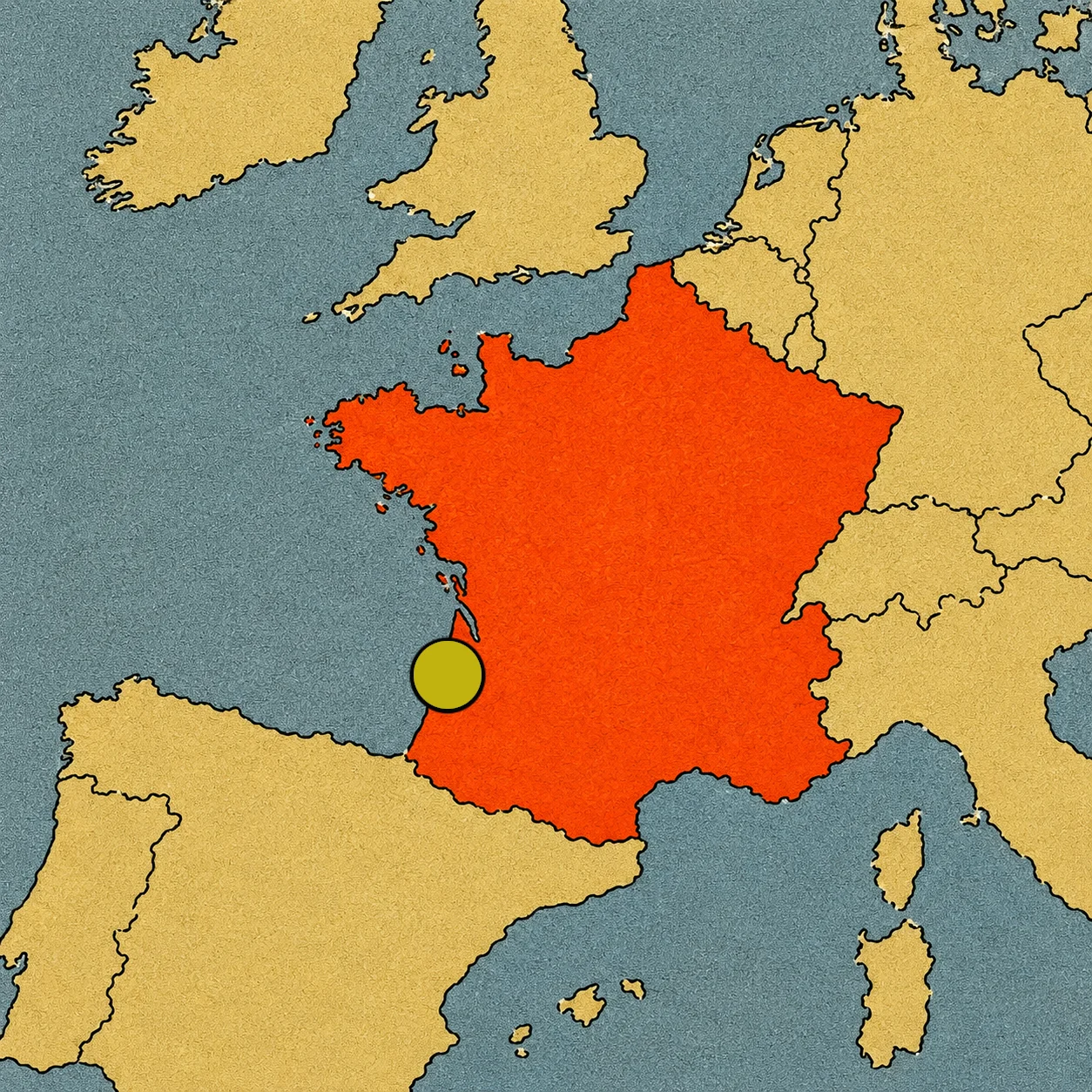
We are not in the Sahara Desert or on a faraway planet. We are on the southwest coast of France, next to the Bay of Arcachon, where you’ll find the Dune of Pilat, the highest sand dune in Europe.[1][2]
A mountain by the sea
The dune is located in the commune of La Teste-de-Buch, in the French region of Nouvelle-Aquitaine. From its summit, you can see a spectacular landscape: the blue of the Atlantic, the sandbars of the Bay of Arcachon, and a green sea of pine tree crowns stretching inland.
Its dimensions are huge for a sand formation. It measures approximately 100 to 105 meters high, about 2.7 kilometers long, and around 500 meters wide, although these numbers change over time.[1][2]
Can you picture its size? Imagine walking the length of 30 football fields along the top of a mountain that can be taller than a 30-story building. And that is not even counting what is beneath your feet: it is estimated to contain nearly 60 million cubic meters of sand.[1]
Where did all that sand come from?
To understand how the dune was born, you have to look at the ocean, the coast, and the wind. Sea currents and waves move sand along the shoreline. When the wind blows from the beach toward the interior, it picks up tiny grains and carries them inland.
When they encounter obstacles, like plants or small bumps in the ground, the sand loses speed and piles up. Little by little, those heaps grow and turn into dunes. The process might seem slow, but over thousands of years, the result becomes gigantic.[3]
The Dune of Pilat didn’t appear all at once. Its formation began about 4,000 years ago through different stages of sand accumulation and plant growth. Climate changes and the force of the winds helped create the dunes we see today.[3][4]
A forest was buried
The history of the dune hides a surprise beneath the surface. Before some layers of sand covered the ground, there was vegetation and even forest areas there. Over time, the sand buried ancient soils and tree remains.
Scientists call these buried ancient soils paleosols. Sometimes, the dark layers that appear among the sand make it possible to recognize them. Plant remains, roots, and other materials can be found in them, which help reconstruct what the landscape was like thousands of years ago.[3][4]
It is as if the dune keeps a history book under its pages of sand. Each layer preserves clues about a different landscape: first there might have been a forest; then more sand arrived; later, vegetation grew back in some places. Nature kept writing and erasing the landscape over and over again.
The dune that never stays still
Many mountains seem motionless. The Dune of Pilat, on the other hand, slowly advances toward the forest. The prevailing winds transport sand from the slope facing the ocean to the one facing inland. Thus, the dune migrates eastward, although its speed changes depending on weather conditions.[1][5]
It is usually estimated to advance between one and five meters per year. That might seem like a short distance, but imagine an entire mountain moving enough each year to cover several parked cars in a row. Over a few decades, that movement can greatly alter the terrain.[1]
How can a mountain move?
The key lies in its two slopes. On the side facing the sea, the wind lifts the grains and pushes them upward. When they reach the ridge, some fall down the face looking toward the forest. Millions of tiny movements continually change the shape of the dune.
The ocean also takes part in this transformation. Waves and storms erode the coastal part, while the wind transports sand inland. Because of this, the dune can gain sand in one area and lose it in another at the same time.[5]
In addition, its height is not always the same. One measurement might show a higher summit than the previous year, while another might record a reduction. The wind, storms, and the movement of the grains make the ridge constantly change.[5]
The forest facing a wave of sand
From afar, the meeting point between the dune and the forest looks like a line drawn across the landscape. But that border changes. As the sand advances, it can cover trees and alter the edges of natural spaces and areas occupied by people.
It is not a wave crashing down in a few seconds, but a slow and continuous movement. The pine trees in its path can end up buried, and the land they once occupied can disappear beneath a new layer of sand.[1][2]
This phenomenon allows us to observe something fascinating: a landscape is not a frozen photograph. Even when it seems eternal, it is constantly changing through the action of wind, water, and the passage of time.
Is there life in so much sand?
You might think a place made of sand is a lifeless desert. However, the coast and the dune are home to organisms adapted to harsh conditions. There are insects, small crustaceans, and birds that take advantage of the resources on the beach and its surroundings. Some birds find food among the natural debris left by the tide.[6]
Plants also play an important role in dune systems. Wherever they manage to grow, their roots help hold some of the sand in place. But the vegetation in these environments is delicate and must withstand wind, salt, and water scarcity.
That is why you shouldn’t uproot plants or take sand as a souvenir. Even though each grain seems insignificant, together they form part of an ecosystem that needs time to recover from disturbances.
A natural treasure we must protect
The Dune of Pilat and the landscape surrounding it have been protected by French legislation since 1943. The protected area was expanded in 1994 to also include the forest massif.[2] This protection helps preserve an exceptional place subject to erosion, the natural movement of sand, and a large influx of visitors.
Caring for the dune does not mean stopping all its changes. Its movement is part of its nature. The challenge consists of protecting the landscape and its living things, managing visitors, and allowing natural processes to continue without causing unnecessary damage.
The mountain that changes grain by grain
The Dune of Pilat looks like an enormous golden mountain between the ocean and the forest. But its greatest secret isn’t just its size: it is that it never stays exacty the same. The wind transports sand, the waves reshape the coast, and the buried layers preserve memories of ancient landscapes.
When you look at a rock mountain, you might think it took millions of years to form. When you look at the Dune of Pilat, remember that a mountain can also be built with millions of tiny grains and keep traveling slowly.
The next time you step on sand, look closely at a single grain. It seems insignificant, but alongside millions of others, it can form one of the most surprising natural wonders in Europe.
Sources
- Réseau des Grands Sites de France, dimensions and movement of the dune — https://www.grandsitedefrance.com/552-les-sites-membres/70-dune-du-pilat
- DREAL Nouvelle-Aquitaine, protection and landscape of the dune — https://www.nouvelle-aquitaine.developpement-durable.gouv.fr/operation-grand-site-de-france-de-la-dune-du-pilat-a1478.html
- National Museum of Natural History of France, dune formation — https://www.mnhn.fr/fr/comment-se-forme-une-dune
- Dune du Pilat, history of its formation — https://www.dunedupilat.com/fr/visiter-la-dune-du-pilat/formation/
- Nouvelle-Aquitaine Coast Observatory, evolution and movement of the dune — https://ladunedupilat.com/une-dune-en-mouvement/
- Town Hall of La Teste-de-Buch, fauna of the dune — https://www.latestedebuch.fr/dune-du-pilat/
- Ministry of Culture of France, 2026 archaeological excavations — https://www.culture.gouv.fr/regions/drac-nouvelle-aquitaine/patrimoines-et-architecture-a-la-drac-nouvelle-aquitaine/l-archeologie-a-la-drac-nouvelle-aquitaine/l-erosion-littorale-revele-un-atelier-de-sel-vieux-de-3-000-ans-sur-la-dune-du-pilat