

Lascaux
Art before history
Imagine finding a hole in a hill, peeking inside, and discovering a dark passageway. You turn on a flashlight, take a few steps, and suddenly, enormous animals painted on the rock appear before your eyes: horses, deer, bisons, and wild bulls. They are not recent drawings or museum decorations. They have been there for about 17,000 years!
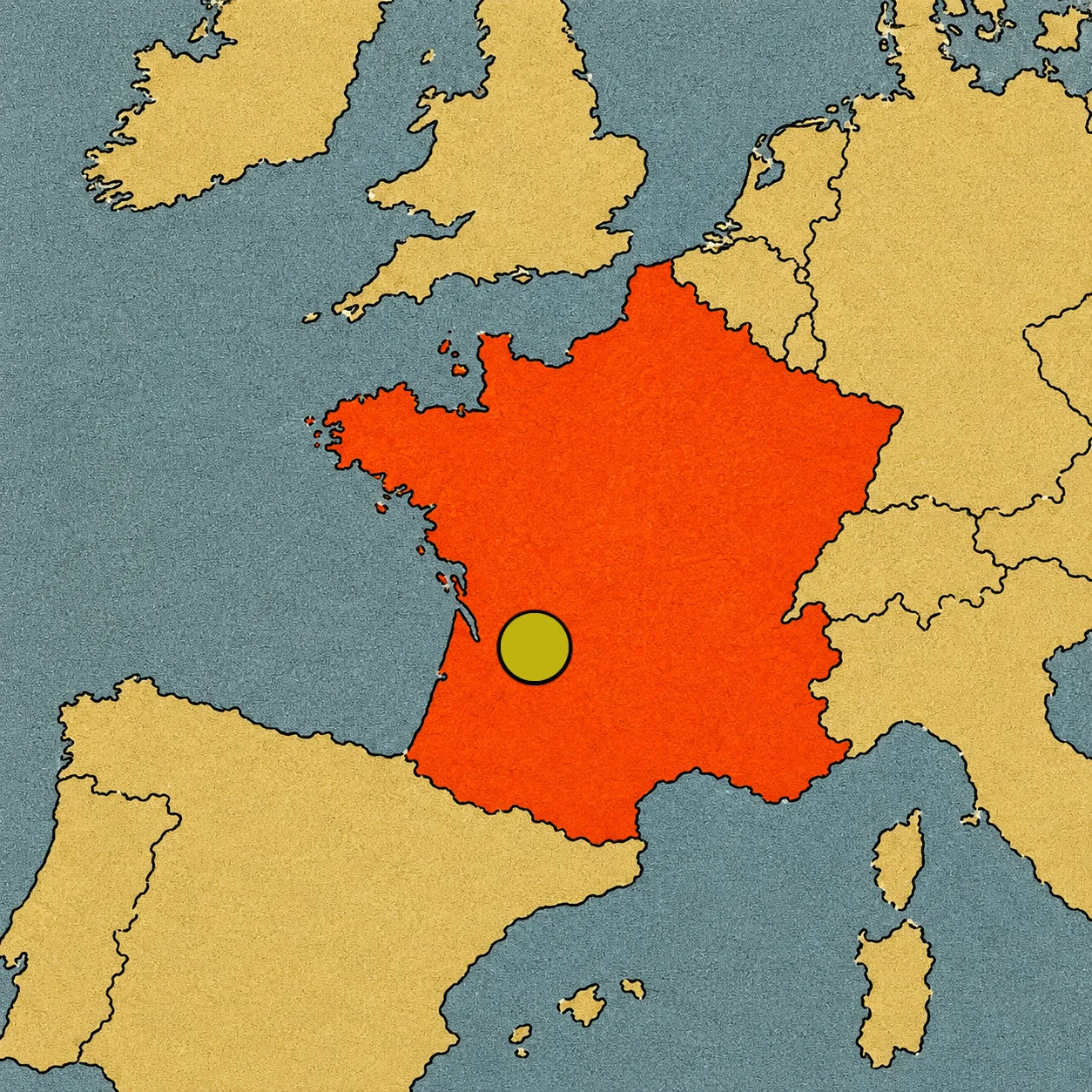
That is, in part, what happened in Lascaux, a cave located near Montignac, in the Dordogne region of France. Its walls preserve some of the most famous prehistoric paintings in the world. Thanks to them, we can peek into a time when modern cities, cars, and writing as we know it did not exist. And the most surprising thing is that its artists lived long before the great pyramids of Egypt were built.[1][2]
Four teenagers and an extraordinary discovery
Let’s travel back to September 1940. Europe was in the middle of World War II, but a very different adventure was about to take place in the French village of Montignac. On the 8th, Marcel Ravidat, a young mechanic apprentice, discovered an opening in a hill while walking with his dog, Robot. A few days later he returned with three friends: Jacques Marsal, Georges Agniel, and Simon Coencas.
On September 12th, the four teenagers managed to enter through the hole. They climbed down a passageway and went into the darkness with an improvised lamp. Then they saw something incredible: the walls were covered with images of animals. These weren’t just a few isolated marks, but an impressive artistic collection that stretched across different galleries.
The boys told their teacher, Léon Laval, what had happened, and the news reached prehistory specialists. The cave began to arouse enormous interest. Those youngsters had found a sort of art gallery hidden underground, created by people who had lived thousands of years before them.[2]
A parade of animals on the rock
Upon entering the cave, one of the most striking places is the Hall of the Bulls. Large animals appear there, some several meters long, painted on the rocky walls and ceilings. Among them, large figures of wild bulls stand out, along with horses and other animals. The shapes adapt to the irregularities of the stone, as if the artists had taken advantage of every curve to bring their drawings more to life.
In other galleries, horses, deer, bisons, felines, and other animals appear. There are also geometric signs, lines, and figures whose meaning is still debated. In total, the collection brings together hundreds of animal representations and numerous engravings. It is not a comic book that tells an easy-to-decipher story: it is a world of images that researchers continue to study.
Why did they paint those animals? Did they want to tell hunting scenes, convey beliefs, teach something to other people, or perform ceremonies? Specialists have proposed different explanations, but there is no definitive answer for all the paintings. What we do know is that those who made them possessed great observation skills and knew how to represent animals with different shapes, sizes, and movements.[1][3]
How did they paint without modern brushes?
The artists of Lascaux didn’t have tubes of paint, markers, or electric spotlights. They used natural materials and techniques adapted to the cave. To get colors, they could use mineral pigments: the red and yellow tones came from lands rich in iron oxides, while black could be obtained from materials like charcoal or certain minerals.
To apply the pigments, they didn’t always need a brush like the ones we use today. They could spread the color with simple tools, with their fingers, or through other procedures. They also made engravings, scraping the surface of the rock to mark lines and details. In some areas, the figures combine painting and engraving, creating different textures.
And there was another challenge: light. Sunlight does not enter the depths of a cave. To work, those artists needed to illuminate the walls with lamps, probably fueled with animal fat. Imagine painting a horse on an irregular ceiling with a small, flickering light that casts shadows. It took skill, patience, and a good idea of how to use the rock’s surface.[3]
Art that seems to be in motion
One of the most surprising things about Lascaux is the way the animals are represented. Some have their legs placed in different positions, their bodies tilted, or their heads turned. The figures do not look like simple symbols drawn at random: many convey energy, as if the animals were about to start running.
The artists also took advantage of the natural shape of the walls. A bulge could help give volume to an animal’s body, while a curve in the rock could become part of its back. Instead of treating the wall as a perfectly flat surface, they worked with the relief in front of them.
That does not mean that all the figures had exactly the same purpose or that we know their creators’ ideas. Prehistoric paintings do not come with written explanations. However, they show us that Paleolithic humans were capable of creating complex and expressive images long before the appearance of writing systems.[1][3]
Why can’t we enter the original cave?
When the discovery became known, many people wanted to visit Lascaux. The cave opened to the public in 1948 and began receiving a huge number of visitors. But breathing inside it, introducing artificial light, and altering its natural conditions had unexpected consequences. The humidity and environmental balance changed, and problems began to appear that threatened the paintings.
In 1963, it was decided to close the original cave to the public to protect it. It was a difficult decision: people wanted to gaze at those extraordinary works, but visits were helping to damage them. From then on, preserving them became a very delicate scientific task.
Today, the original cave remains closed to visitors. But that doesn’t mean we have to give up discovering it. In 1983, Lascaux II opened as a partial reproduction, and in 2016 Lascaux IV inaugurated the International Center for Cave Art, which replicates practically the entire cave and allows visitors to explore its main spaces. Specialists used detailed studies, three-dimensional models, and artistic techniques to recreate the walls, their reliefs, and the paintings.[2][4]
A message from thousands of years ago
Lascaux is part of the prehistoric sites and decorated caves of the Vézère Valley, inscribed on the UNESCO World Heritage List in 1979. Its importance is not solely because its paintings are pretty or ancient. They also help us better understand human creativity and the relationship that prehistoric communities maintained with animals and their environment.[5]
There are still unanswered questions. We don’t know for sure what each image meant, why certain animals were chosen, or how all the activities related to the cave were organized. Archaeologists compare the paintings with other finds, study the pigments, and analyze the techniques used to get closer to those answers.
The fascinating thing is that a work created about 17,000 years ago can still surprise us. The people who painted Lascaux lived in a world very different from ours, but they knew the thrill of observing an animal, imagining a figure, and leaving an image for others. Their names have been lost, but their art is still here.
Exploring Lascaux is like setting off on a small adventure through time. Every painted animal is a clue; every sign, a question; every room, a new opportunity to imagine how those who entered there thousands of years ago lived. We cannot truly travel back to prehistory, but we can follow their footsteps, investigate their mysteries, and discover that, sometimes, one of the greatest adventures consists of trying to understand those who lived long before us.
Sources
- French Ministry of Culture: rock art and Lascaux paintings — https://archeologie.culture.gouv.fr/lascaux/en
- Official Lascaux site: history of discovery and conservation — https://lascaux.fr/en/history-of-lascaux/
- French Ministry of Culture: resources on Lascaux paintings and galleries — https://archeologie.culture.gouv.fr/lascaux/en
- French Ministry of Culture: reproduction of the cave in Lascaux IV — https://archeologie.culture.gouv.fr/lascaux/en/lascaux-iv
- UNESCO: prehistoric sites and decorated caves of the Vézère Valley — https://whc.unesco.org/en/list/85/