
Prague’s Clock
The Prague Astronomical Clock: the clock that could tell time, the Sun, and the Moon
In a square in Prague there is a clock that has been running for more than 600 years. It does not need electricity to move and, every hour, its figures come to life.
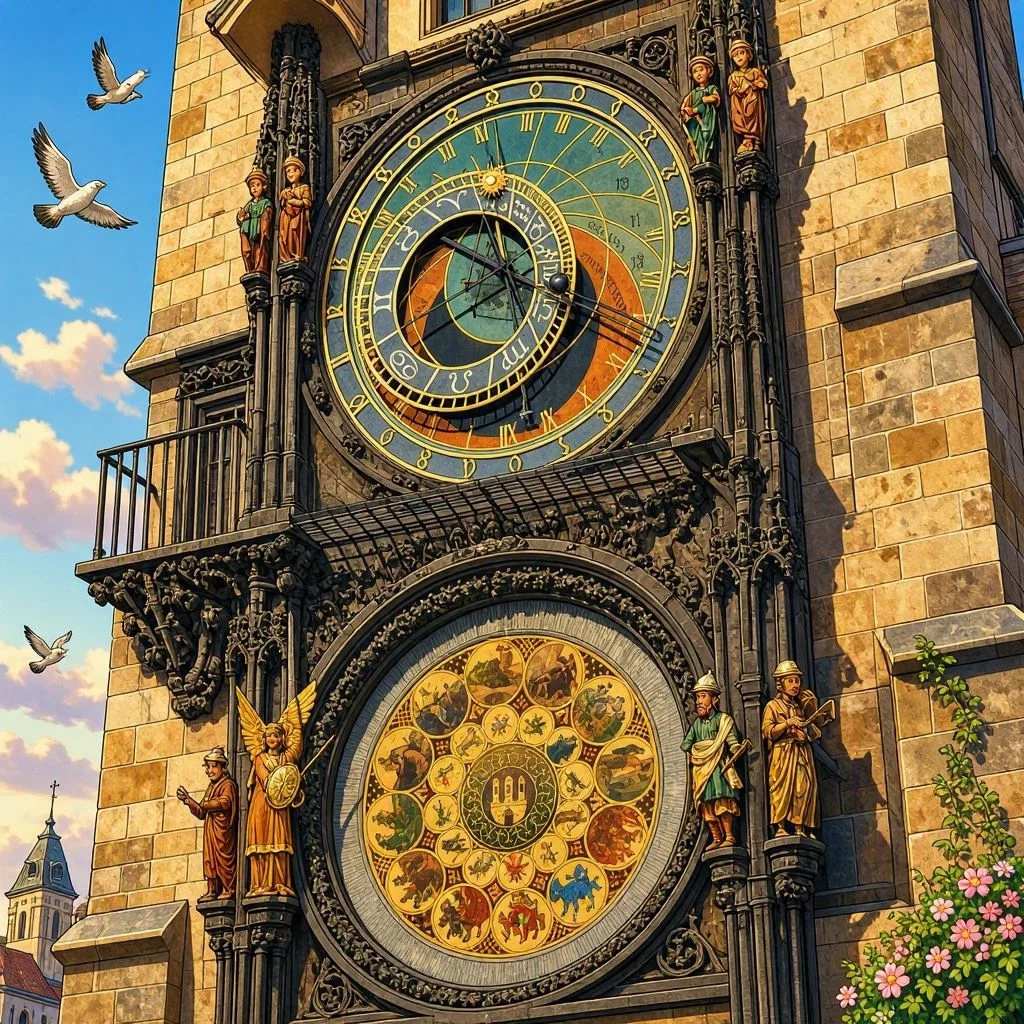
On the facade of the old Prague Town Hall there is something that looks like much more than a clock. It has numbers, symbols, a Sun, a Moon, stars, and several figures that move when a certain hour arrives. It is the Prague Astronomical Clock, one of the oldest medieval astronomical clocks still in operation.
Its main part was installed in 1410. At that time there were no telephones, digital clocks, or electricity. But the inhabitants of Prague could already look up and discover something extraordinary: a mechanism capable of showing how time advanced and where the Sun and the Moon were in the sky.
A clock that runs without electricity
Today we are used to a clock running on a battery or connected to electricity. The one in Prague works in a completely different way. Inside it there is a complex system of cogwheels, gears, and shafts.
The movement begins thanks to a clock mechanism that drives those wheels. Each gear transmits the movement to another and, through different rotation speeds, manages to move the different parts of the dial. It is similar to an enormous mathematical machine made of metal. One wheel may need to turn many times while another turns much more slowly.
Thus, a single mechanism can control the hands, the astronomical symbols, and other parts of the clock. No batteries. No electric motors. Only mechanics and precision.
The Sun and the Moon also have their place
The astronomical dial is the most striking part of the clock. It is not designed solely to say “it is three o’clock” or “it is six o’clock.” Its function is to represent different aspects of the apparent movement of the celestial bodies.
The clock shows the position of the Sun and the Moon relative to the sky and allows information related to the time of day, the position of the Sun, and other astronomical cycles to be read. Symbols of the zodiac also appear on the dial.
The great idea behind all of this is fascinating: in the Middle Ages, observing the sky was one of the fundamental ways of understanding how the year passed. The clock turned part of that astronomical information into something that could be contemplated directly in a square.
A Moon that changes its appearance
One of the most curious pieces is the representation of the Moon. Its dial shows different phases, so it can be seen whether the Moon is waxing, full, or waning.
This made a lot of sense in an era when the sky was a kind of natural calendar. Without light pollution and without cities lit up as they are today, observing the Moon and the stars was part of everyday life.
The clock brought together in a single machine something we do today with several apps: knowing the time, following the calendar, and observing the cycles of the sky.
And then, the figures move
But the clock holds a surprise that is not astronomical. Every hour, a small door opens at the top and a parade of figures begins. The famous Twelve Apostles appear, passing one after another in front of the windows.
Meanwhile, other figures located around the clock also move. Among them are Death, represented by a skeleton that rings a bell, and other figures that symbolize different aspects of society and human life.
The scene does not last long. Then the doors close and the clock becomes still again. Until the next hour arrives.
Death keeps count
The easiest figure to recognize is probably Death. The skeleton holds a small hourglass and pulls a rope to ring a bell. The message was quite clear to people in the Middle Ages: time passes for everyone.
The clock was not only used to measure the hours. It also reminded people of something that was very present in daily life at that time: human life is limited.
That is why the mechanism combines practical information, astronomy, and symbols about human existence. It is a clock, but it is also a kind of story told with gears and figures.
How was time measured in the Middle Ages?
Here there is an important difference from our way of thinking.
Today we divide the day into 24 equal hours. But for much of the Middle Ages, the way daily time was organized was different.
The day was traditionally divided according to the canonical hours, related to times of prayer. In addition, the hours of light and darkness were enormously important.
In Europe, bells were also used to announce specific moments of the day. That is why a large public clock such as the one in Prague had a very important function. Not everyone had a personal clock. The clock in the square could become the clock for the entire city.
A clock for everyone
Imagine Prague hundreds of years ago. There are no mobile phones in pockets. There are no digital clocks in stations. There are no screens showing the time in the streets.
But you can be walking through the square and hear a bell. You look up. The clock tells you the time and, when the moment arrives, its figures begin to move. The mechanism turns a technology that was very advanced for its time into a public spectacle.
More than six centuries later
The Astronomical Clock has survived wars, political changes, fires, and numerous repairs.
Not all of its current parts are medieval: the mechanism and the different parts have been restored and modified over the centuries. But the fundamental idea remains the same. A mechanism built in an era without electricity still sets in motion one of Prague’s most famous attractions.
And perhaps that is the most impressive part. It is not only old. It still works.
Wonder
The Prague Astronomical Clock is a wonder because it manages to bring together in a single machine something that seems impossible: measuring time, representing the movement of the Sun and Moon, showing the calendar, and telling a story with figures that come to life every hour.
More than 600 years ago, someone built a machine to understand the sky and measure the passage of time. And every time its figures move again, the past starts moving again.