
Czechoslovakia
The country that split in two without a war
For more than seventy years, Czechoslovakia appeared on the maps of Central Europe. It had a capital, a flag, a government and millions of inhabitants. But on January 1, 1993, the name Czechoslovakia stopped appearing on maps.
And it was not because it had been conquered. Nor because it had lost a war. Nor because another country had invaded it. It simply ceased to exist, and two new countries appeared: the Czech Republic and Slovakia.
A country born of a war
To understand how it happened, we have to go back to the end of World War I.
Between 1914 and 1918, Europe was at war. The conflict pitted the Central Powers, mainly Germany and Austria-Hungary, against the Allies, among them France, the United Kingdom, Russia, Serbia, Italy and, from 1917 onward, the United States.
Austria-Hungary was defeated and the enormous empire fell apart. New states emerged from its former territories. One of them was Czechoslovakia, created in 1918.
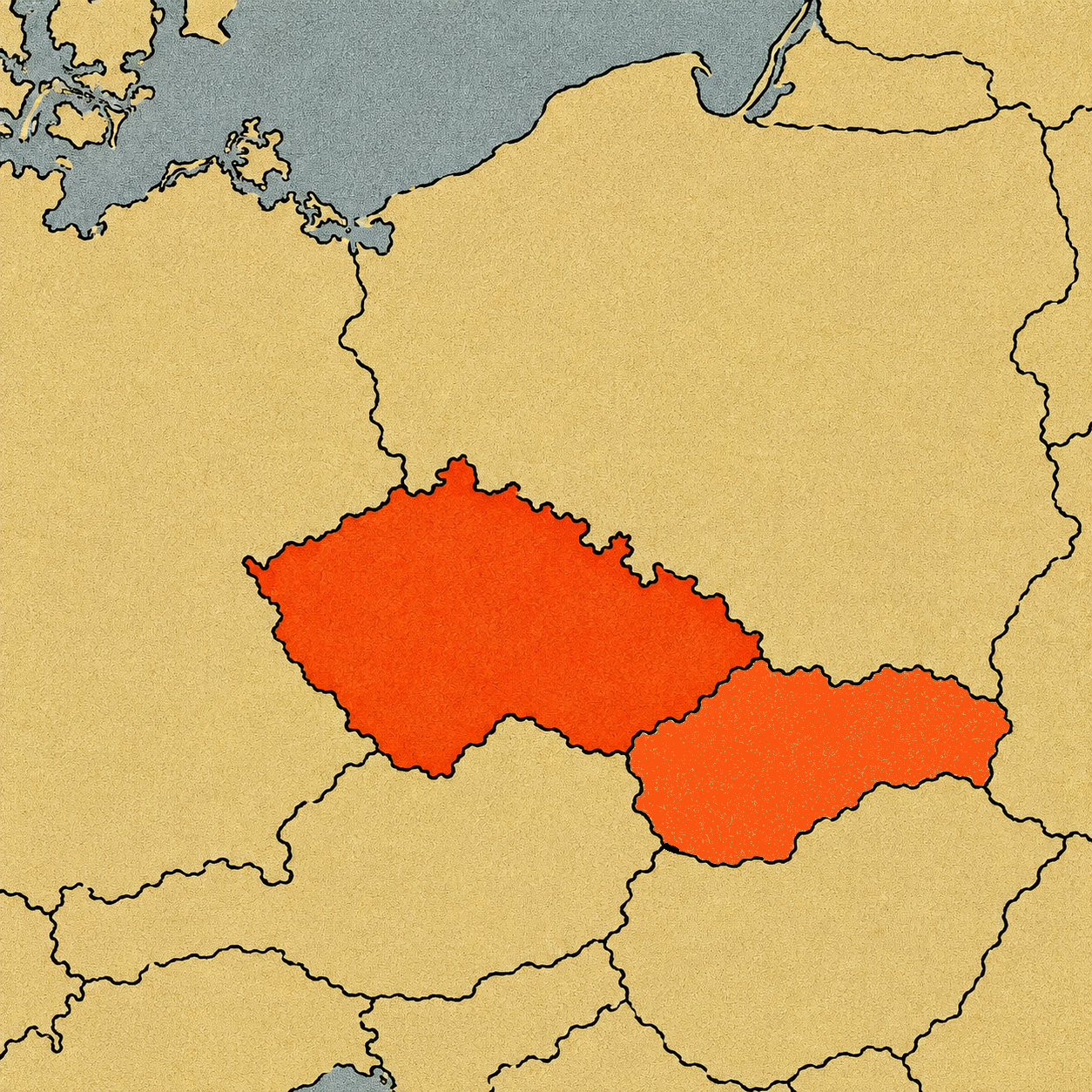
The new country brought together mainly two large peoples: the Czechs, concentrated above all in Bohemia and Moravia, and the Slovaks, who lived to the east, in Slovakia. On the map it looked like a single nation. But within its borders different peoples, languages and histories coexisted.
Prague and Bratislava
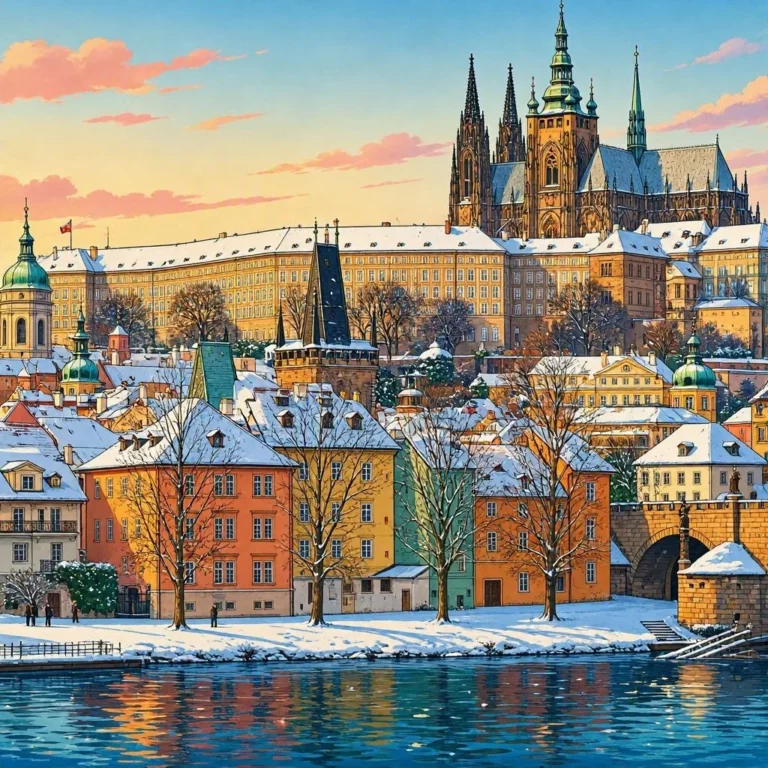
The capital was Prague, one of the most important historic cities of Central Europe. To the east was Bratislava, which would become the main city of Slovakia.
Czechs and Slovaks shared many things, including closely related languages, but they also had historical and cultural differences.
During the 20th century, moreover, the country went through some of the most difficult periods in European history. Nazi Germany occupied Czechoslovakia in 1938-1939, and after World War II the country remained within the Soviet sphere of influence.
In 1948, the communists took power. For decades, Czechoslovakia was part of Europe’s communist bloc.
The Velvet Revolution
Everything began to change in 1989. In November of that year, large demonstrations against the communist regime began. Students, artists and thousands of citizens took to the streets. The protests were mostly peaceful and the regime eventually fell.
The process was given a name that sounds like something out of a fairy tale: the Velvet Revolution. The writer and dissident Václav Havel became president shortly afterward. Czechoslovakia had recovered democracy.
But now a new question arose: Should the country continue to exist as a single nation?
Two different paths
After democracy was restored, talks began about the country’s future.
An important part of the Czech and Slovak population had different ideas about how the State should function. In Slovakia there was a growing desire for greater autonomy and the ability to make its own decisions.
The politicians Václav Klaus, on the Czech side, and Vladimír Mečiar, on the Slovak side, negotiated the future of the federation. And here is what is extraordinary: they did not decide to fight over territory. They decided to divide it through negotiations.
The country that disappeared
Finally, it was agreed to separate Czechoslovakia. At midnight on December 31, 1992, the country ceased to exist. And when January 1, 1993 began, the map showed two States: the Czech Republic and Slovakia.
The process received a curious name: the Velvet Divorce, in reference to the Velvet Revolution that had ended the communist regime.
It was an extraordinarily peaceful political separation. There was no war between Czechs and Slovaks. There were no armies facing off in the streets. There was no invasion. A country ceased to exist because its representatives agreed that it was better to create two countries.
What happened to everything else?
Dividing a country means resolving countless things. What happens to the army? To the currency? To the embassies? To government buildings? To borders? To citizens’ documents?
Czechoslovakia had to distribute its institutions and assets between the two new States. A new international border also had to be established. The separation was relatively quick because both countries had already been part of the same federation and there were distinct institutions for their territories.
The former Czechoslovakia disappeared, but people continued living in their same cities and towns.
Two countries, two currencies
For a brief period, the two new countries shared a currency. But the monetary union lasted only a few weeks. In February 1993, the Czech Republic introduced the Czech koruna and Slovakia the Slovak koruna. Banknotes and coins also had to be replaced and banks, contracts, and financial systems adapted.
It is a good example of something we normally do not see when we look at a map: a new border can also change things as everyday as the money you carry in your pocket.
A border that hardly looks like a border
Today, the border between the Czech Republic and Slovakia can seem surprisingly quiet. Both countries are part of the European Union and the Schengen Area, so it is usually possible to travel between them without ordinary border controls.
Moreover, their languages are similar enough that Czechs and Slovaks can understand each other with relative ease. That is why it is curious to look at a current map and remember that, until 1992, all that territory belonged to the same country.
When a map changes without a war
The history of Czechoslovakia shows that countries do not always disappear in the same way. Some disappear after wars. Others after revolutions. Others when they are conquered or incorporated into another state. Czechoslovakia did something different: it negotiated its own disappearance.
On the last day of 1992, there was a country called Czechoslovakia. The next day, there were two. Sometimes, one of the most surprising transformations of a map does not occur on a battlefield, but around a negotiating table.