
Studenica
Medieval Treasure
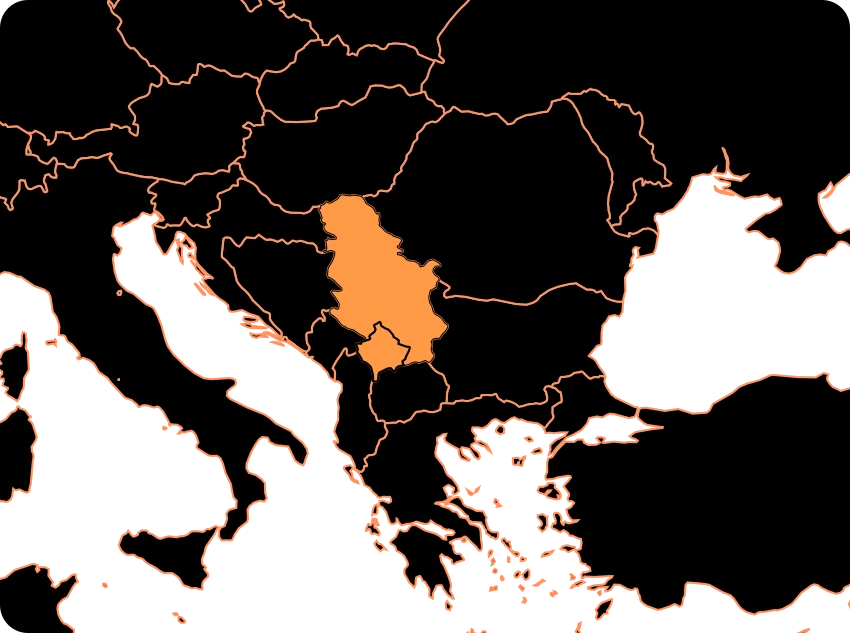
In the middle of the mountains, a monastery guards marble churches, king’s tombs, and paintings that are nearly 800 years old.
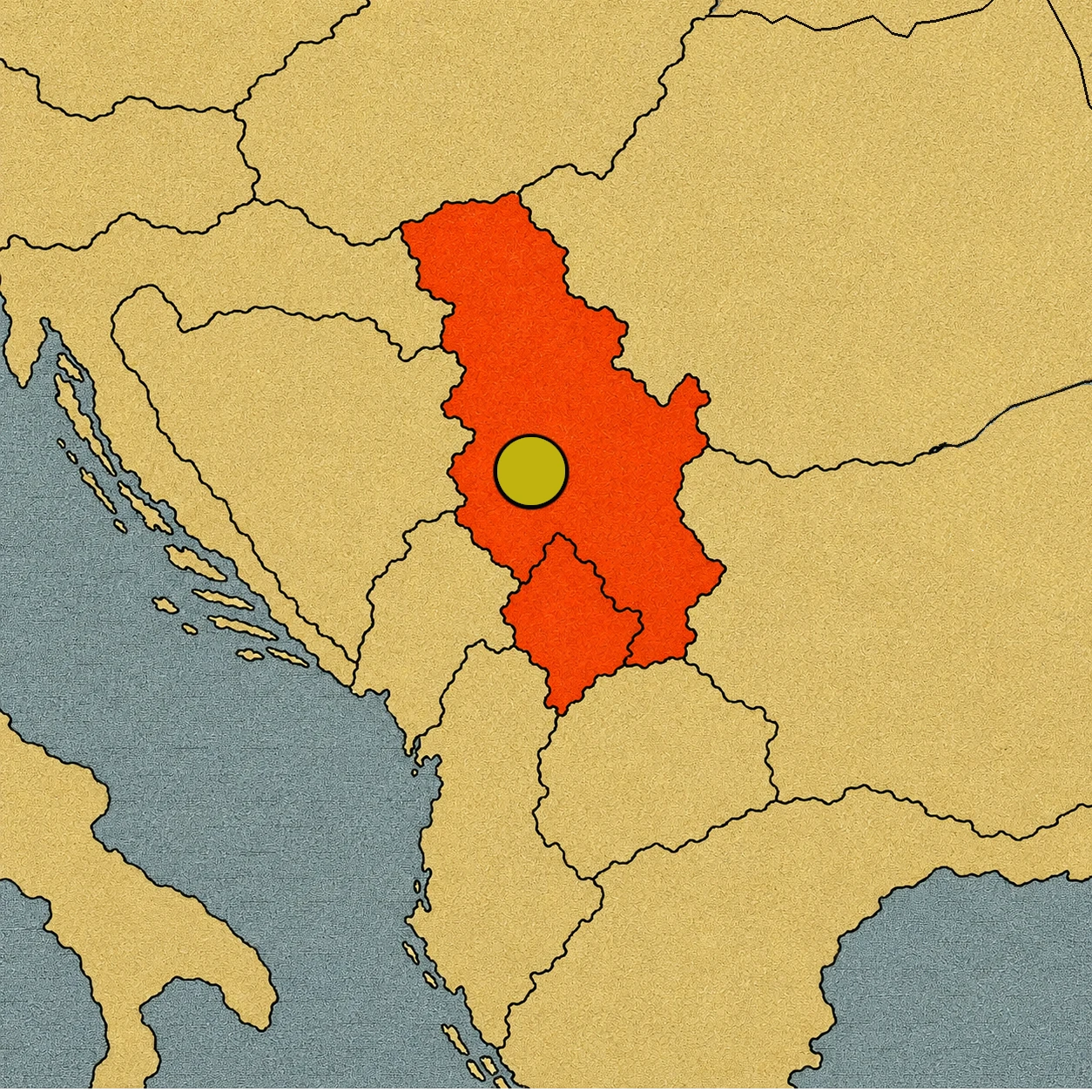
That place is Studenica, in the center of modern-day Serbia. Founded in the late 12th century by Stefan Nemanja, it became one of the great spiritual and cultural centers of medieval Serbia. Its walls protected churches, monastic buildings, valuable objects, and, above all, a collection of art that offers a glimpse into a time when Serbia was growing between two great worlds: the Byzantine and the Western.[1][2]
That is why Studenica is not just an old monastery. It is like a small time capsule.
A Monastery in the Mountains
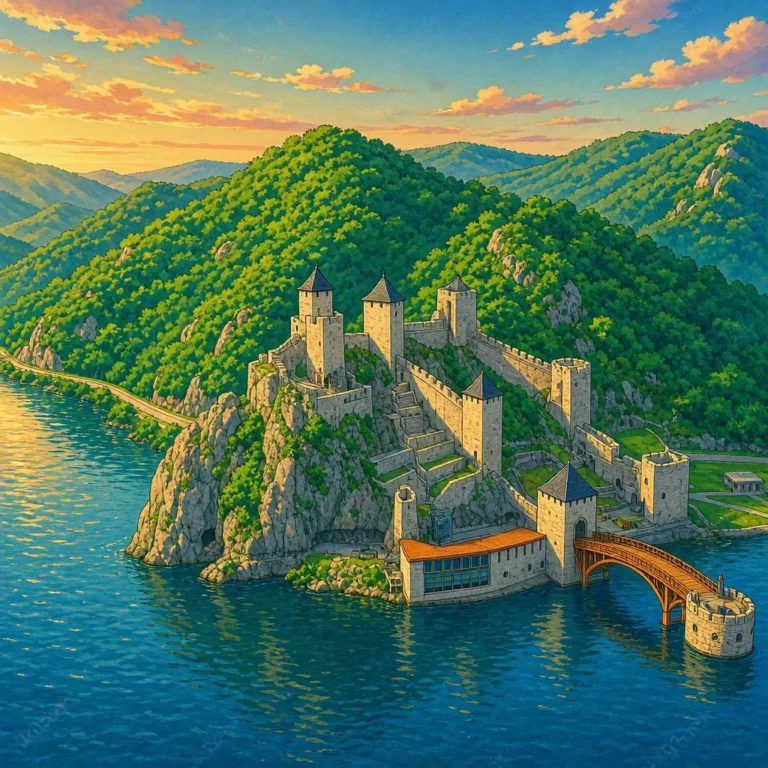
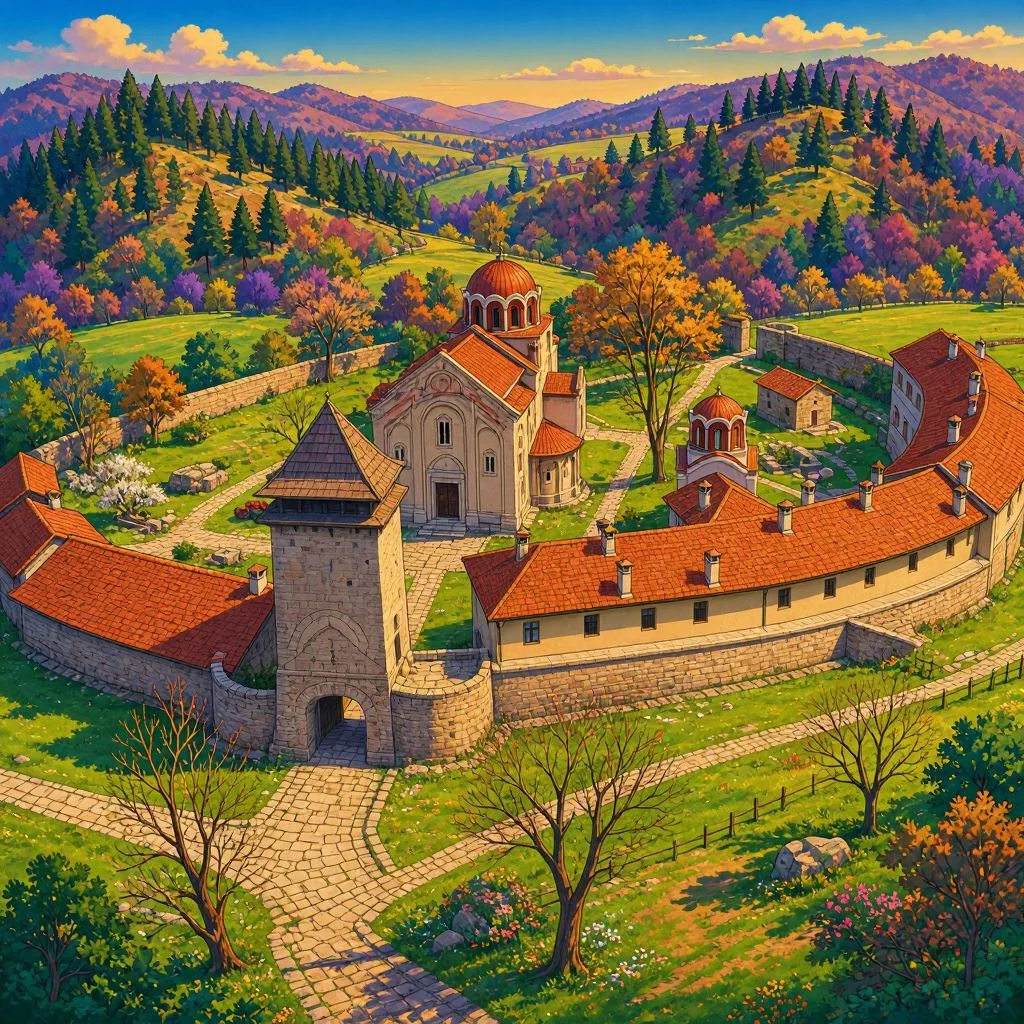
Studenica is located next to the river that gives it its name, in a mountainous region of central Serbia. When you arrive at the complex, the first impression can be surprising: its walls and gates make it look almost like a small fortress.
The site is surrounded by an almost circular wall, reinforced with two fortified gates. Inside are the main churches and other monastic buildings. In the surrounding area, there are also hermitages, old marble quarries, and the remains of the settlement where those who quarried and worked the stone lived.[1]
In other words, Studenica was not just an isolated church in the woods. It was a small world organized around religious life, work, and the preservation of knowledge.
The White Marble
The architectural star is the Church of the Virgin, built with large blocks of white marble. At first glance, it might look like a Western-style church. Its facades have portals, windows, and Romanesque-inspired reliefs, with very detailed stone decoration. But its interior layout belongs to the tradition of the Eastern Church.[1][4]
That combination is one of the keys to understanding Studenica. During the Middle Ages, Serbia was in a contact zone between cultures. On one side was the Byzantine world, with Constantinople as its great artistic and religious center. On the other, Romanesque influences arrived from the Adriatic coast and Western Europe.
The builders and artists did not have to choose between one world and the other. They mixed them. From that combination was born the so-called Raška architectural school, a medieval style that achieved one of its first and most important expressions precisely in Studenica.[1][4]
What is the Raška School?
The Raška school was not a school like the ones we know today, with classrooms and teachers. It is the name art historians use to describe an architectural tradition developed in medieval Serbia, especially between the 12th and 13th centuries.
Its churches usually combine a religious structure of Byzantine tradition with an exterior appearance that incorporates Romanesque elements. In Studenica, that mixture is clearly visible: the interior leads towards the spiritual Byzantine world, while the marble exterior features portals, arches, and sculptures that recall Romanesque art.[1][4]
Walls That Tell Stories
If the marble makes Studenica stand out on the outside, the frescoes make it surprising on the inside. The walls of its churches are covered with medieval paintings. Some were made in the early 13th century and others belong to the 14th century.[1]
At a time when books were very rare objects and many people could not read, images were enormously important. The frescoes showed religious scenes, characters, events, and symbols that could be viewed directly on the walls.
But the frescoes of Studenica are not simple illustrations. The artists sought to represent faces, gestures, movement, pain, and solemnity. The figures seem to have weight and volume. The colors and compositions create scenes that can still impress anyone who enters the churches today.
Painters Who Arrived from Far Away
Another building in the complex shows that the monastery continued to be a major artistic center long after its foundation. It is the so-called King’s Church, built in 1314 at the initiative of King Milutin.[1]
To decorate it, two painters from Thessalonica, Michael and Eutychios, artists of great prestige in the Byzantine world, were called in. Their frescoes depict scenes from the life of the Virgin Mary and stand out for the way they construct faces, light, shadows, and the intensity of the colors.[1]
The result looks almost like a movie paused on the walls. There are characters, buildings, landscapes, and events organized in sequences. Looking at them is like opening a medieval book that, instead of pages, has walls.
A Place Where Rulers Rest
Studenica also preserves a very important part of the history of the Nemanjić dynasty. In the Church of the Virgin are the remains of Stefan Nemanja, the founder of the monastery, who was later venerated as Saint Simeon. Also connected to the complex are the remains of his wife Anastasia.
And the tomb of Stefan the First-Crowned, the first king of Serbia, is preserved there.[1] This turns the monastery into something resembling a stone archive. The tombs tell who some of the rulers of the era were.
Saint Sava and a Great Change
Among all the figures connected to Studenica, one stands out as especially important: Saint Sava. He was the youngest son of Stefan Nemanja and a fundamental figure in medieval Serbian culture and Church history.
In 1219, from Studenica, Sava initiated the process that led to the independence of the Serbian Orthodox Church from the Ecumenical Patriarchate.[1] This event had consequences far beyond the walls of the monastery. The new organization of the Church helped consolidate its own religious institutions and strengthened the cultural development of medieval Serbia.
Saint Sava was also connected to writing and education. UNESCO notes that in Studenica he wrote one of the first literary works in the Serbian language.[1]
That is why the monastery was much more than a place of prayer. It was also a place where texts were copied, knowledge was transmitted, and a cultural tradition was built.
A Capsule of Medieval Serbia
In 1986, Studenica was inscribed on the UNESCO World Heritage List.[1] The organization highlights its architecture, its paintings, and its importance for medieval Serbian history. It also notes that the complex preserves not only the churches, but also monastic buildings, hermitages, marble quarries, and the remains of a settlement related to the stone workers.[1]
Wonder of Humankind
Studenica fits into this category for an extraordinary reason: it preserves many different pieces of the same story. The Raška school left a rare mixture of East and West on its walls. The frescoes preserved images created nearly 800 years ago. The tombs remember the first great rulers of medieval Serbia. And the presence of Saint Sava connects Studenica with the birth of an independent Serbian Orthodox Church.[1]
Therefore, when you walk through one of its gates, you are not simply entering a monastery. You are entering a piece of the Middle Ages that is still standing. And perhaps that is its greatest wonder: Studenica not only preserves medieval Serbian history. It turns it into a place we can still walk through.
Sources:
1. UNESCO — History, architecture, frescoes, tombs, Saint Sava, and World Heritage of Studenica — https://whc.unesco.org/en/list/389
2. Tourism Organization of Serbia — Studenica and its role as a medieval spiritual and cultural center — https://www.serbia.travel/es/valley-of-the-kings/
3. Tourism Organization of Serbia — World heritage and artistic features of Studenica — https://www.serbia.travel/en/world-cultural-heritage/
4. Tourism Organization of Serbia — Raška school and mix of Romanesque and Byzantine influences — https://www.serbia.travel/en/transromanica/