


Falkland Islands
The Islands That Two Countries Claim as Their Own
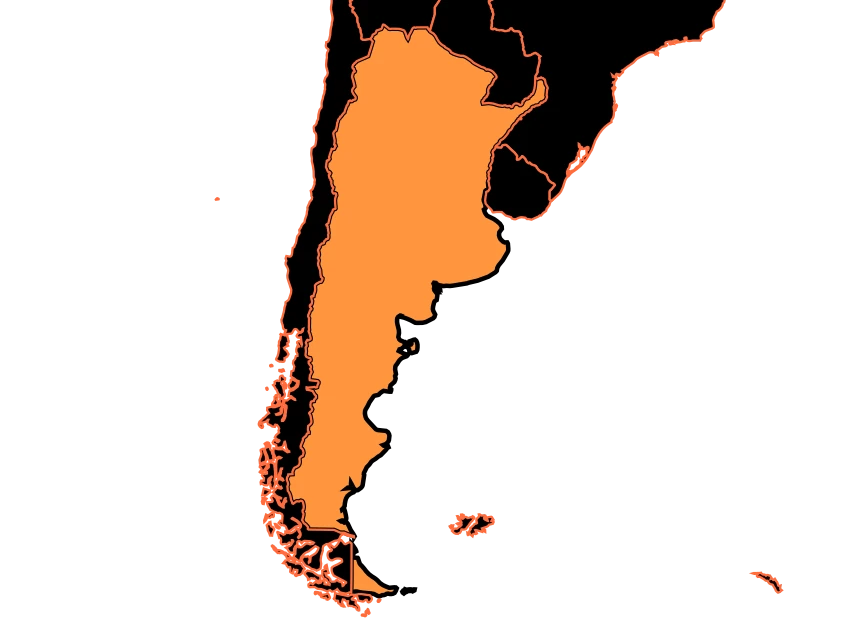
At the southern tip of the Atlantic Ocean lies a small group of islands that, despite being far from the world’s major capitals, has been part of an international dispute for centuries. These are the Malvinas Islands, known as the Falkland Islands in the United Kingdom. Today they are administered by the UK, but Argentina claims sovereignty over them.
Behind this dispute lies a story of explorers, colonization, wars, maps, and a question that still has no answer accepted by both sides: Who do the islands really belong to?
Islands in the Middle of the Atlantic
The Malvinas form an archipelago located about 500 kilometers from the Argentine coast. There are two main islands, East Falkland and West Falkland, accompanied by hundreds of smaller islands and islets.
The landscape is dominated by hills, rocky coasts, beaches, and vast open spaces. The climate is cold, windy, and changeable. At first glance, they may seem like remote islands of little importance. But their position in the South Atlantic made them a territory of strategic interest for centuries.
A History with Many Players
The history of the Malvinas is complicated because different European powers carried out explorations and made claims over the islands during the 17th and 18th centuries. The French and British established settlements at different times. Spain also exercised control over the islands when they were part of its empire.
At the beginning of the 19th century, wars and independence movements completely transformed the map of South America. And it was then that the question of who should control the islands took on a new dimension.
Argentina Claims the Islands
Argentina maintains that it inherited territorial rights over the islands from Spain after its independence. In 1820, the authorities of the United Provinces of the Río de la Plata formally proclaimed their sovereignty over the Malvinas. In the following years, there was an Argentine presence and administration.
But the situation changed in 1833, when British forces regained control of the islands. Since then, the UK has maintained its administration, except for a brief period of Argentine occupation in 1982.
Argentina has never abandoned its claim.
Why Does the UK Consider Them British?
The British position is different. The UK maintains that it has sovereignty over the islands and highlights the continuity of its administration since the 19th century.
It also considers the will of the current inhabitants to be important. The population of the islands largely identifies as British and has expressed in referendums its desire to maintain the link with the UK.
This gives rise to two different arguments: Argentina emphasizes territorial history and geographic proximity. The United Kingdom highlights continuous administration and the will of the inhabitants. Both countries hold incompatible positions.
The 1982 War
The dispute reached its most dramatic moment in 1982. On April 2, Argentina occupied the islands. The United Kingdom responded by sending a large military force to the South Atlantic to recover the territory.
For more than two months, there were battles on land, at sea, and in the air. Finally, Argentine forces surrendered on June 14, 1982. The war left hundreds of soldiers dead from both countries and had profound political consequences in both Argentina and the United Kingdom.
But one thing did not change: the territorial dispute continued.
The Islands After the War
After 1982, the United Kingdom significantly reinforced its military presence on the islands. Local infrastructure was also developed, and the importance of activities such as fishing and tourism grew.
The population lives mainly in Stanley, the capital and main settlement. Today, the islands have a local government and a small population, but they remain under British sovereignty. Argentina continues to claim them.
What Does the United Nations Say?
The issue has also reached the United Nations. The UN considers that there is a sovereignty dispute between Argentina and the United Kingdom and has urged both countries to find a solution through negotiations.
However, Argentina and the United Kingdom do not agree on how the issue should be addressed. That is why, decades after the war, the dispute remains unresolved.
And What Do the Inhabitants Want?
Here, a fundamental part of the story emerges. The people currently living in the Falklands have their own identity and have clearly expressed their position. In the 2013 referendum, the vast majority of voters supported maintaining the status of a British Overseas Territory.
It should also be noted that the population of the Falklands is not native. According to the latest census conducted in 2021, there are 3,662 people residing in the Falklands from 60 different countries, with St. Helena (a British Overseas Territory) at 10% and Chile at 6% being the most represented.
This makes the dispute even more complex. It is not just about two governments looking at a map. There is also a population living there with its own opinion about the future of the islands.
A Small Territory with an Enormous History
The Falklands show that a territory can be small and yet hold enormous historical and political significance.
European explorers reached these waters. Empires fought over their control. Argentina claimed them after gaining independence. The United Kingdom established and maintained its administration. In 1982, two countries went to war over them. And even today, Argentina and the United Kingdom maintain opposing positions on their sovereignty.
A disputed territory
The Falkland Islands fall under the category of disputed territory because their sovereignty remains the subject of an international claim.
For the United Kingdom, they are the Falkland Islands, a British overseas territory. For Argentina, they are the Islas Malvinas, part of its national territory.
Meanwhile, the people living there continue their daily lives on remote islands in the South Atlantic. A small patch of land on the map that has reminded us for generations that borders are not always as simple as they seem.