
Kourou
The space base that gave Europe autonomy
Three, two, one… blastoff! A roar breaks the silence of the tropical rainforest. A huge column of fire lights up the sky, and a rocket begins to rise, leaving the coast of South America behind. Inside travel satellites that will soon be orbiting the Earth.
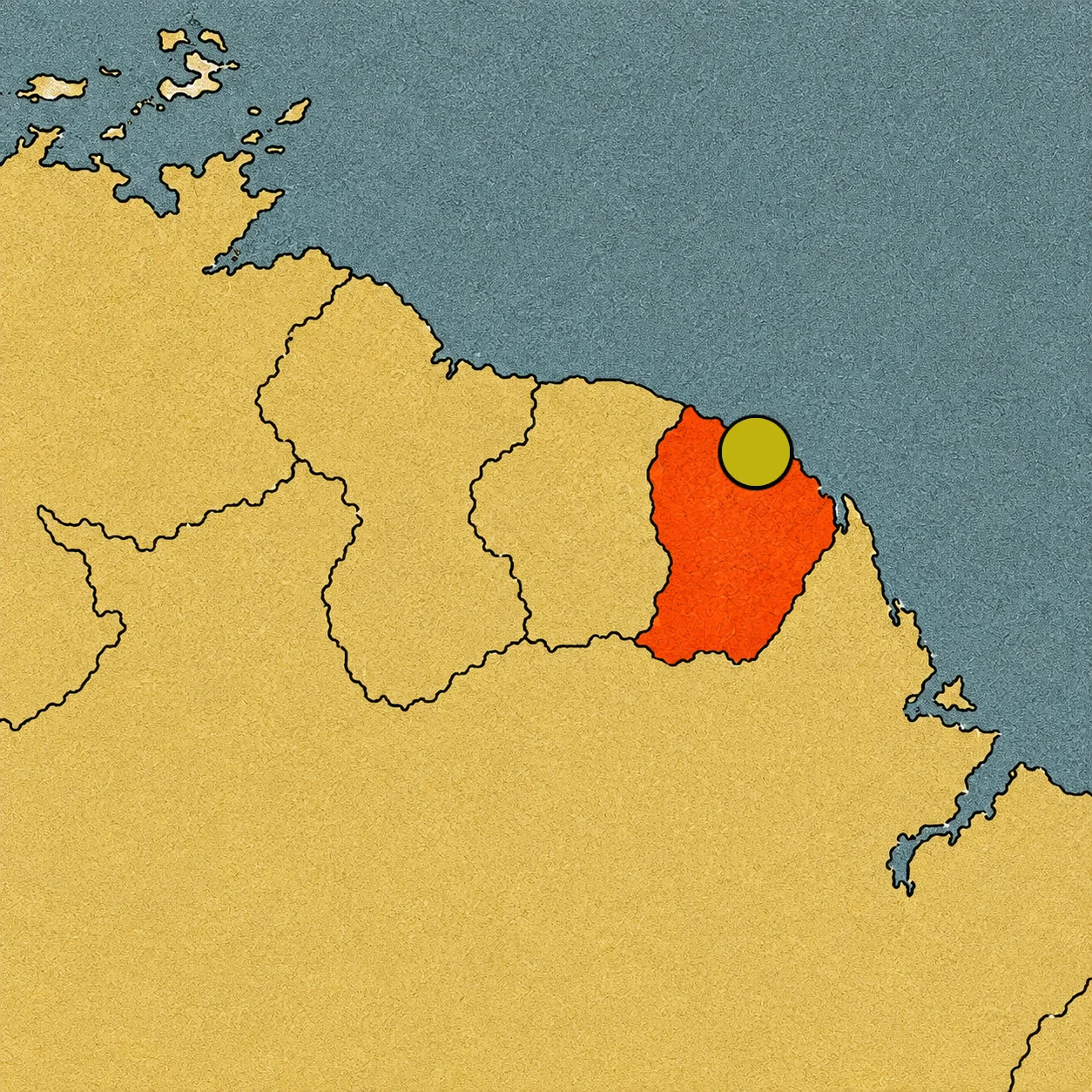
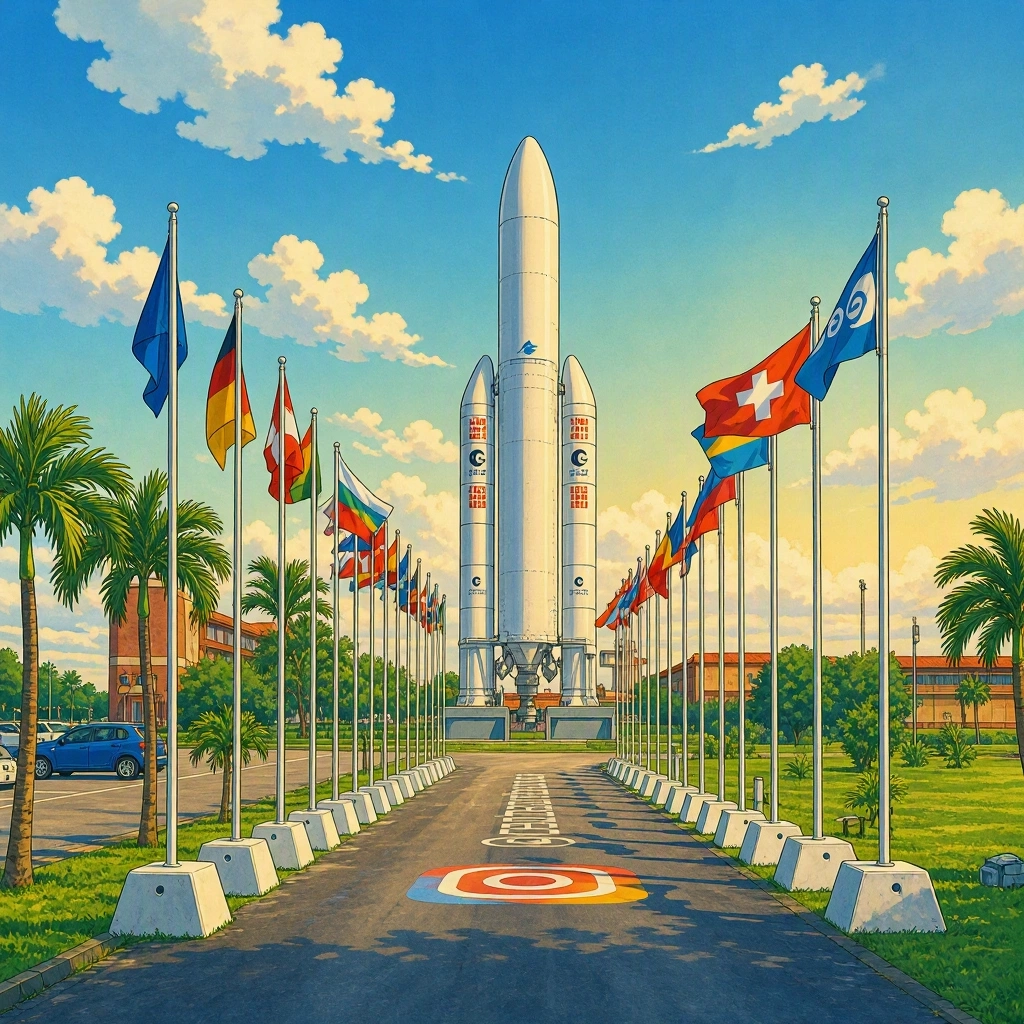
This scene takes place in Kourou, in French Guiana, a territory of France located in South America. There you will find Europe’s Spaceport, a base from which satellites and space missions are launched. But its story is much more than a collection of rockets: Kourou helped Europe achieve something fundamental: the ability to send its own satellites into space without necessarily depending on other powers.[1][2]
Why did Europe need its own rocket?
Imagine that several countries want to study the climate, communicate using satellites, or explore the universe. They can build satellites with advanced technology, but there is a problem: someone has to take them up into space.
A satellite cannot reach its orbit on its own. It needs a rocket capable of lifting it from Earth and accelerating it until it reaches the right speed. Without its own launch system, a country or organization must hire someone else to put its satellites into orbit.
During the early years of the space race, the United States and the Soviet Union dominated a large part of this activity. Europe also wanted to research space, but it understood that manufacturing satellites was not enough: it needed to develop its own launchers and have a base from which to use them.[2][3]
From Algeria to the South American jungle
The story began before Europe’s current Spaceport even existed. France carried out its first space activities from facilities located in Algeria, which was then under French administration. When Algeria became independent in 1962, France had to look for another location to continue its launch program.[4]
In 1964, the French government chose Kourou out of fourteen locations studied. The area offered several advantages: it was close to the equator, had access to the Atlantic Ocean, and made it possible to establish launch facilities in a territory with room to develop them.
Construction began during the 1960s. In April 1968, the space center carried out its first launch with a Véronique sounding rocket. Two years later, in 1970, a French Diamant-B rocket put the DIAL-WIKA satellite into orbit, one of the first major milestones of the space activities carried out from Kourou.[1][4]
A French base becomes European
In 1975, the European Space Agency was born, known as ESA for its English acronym. Its member countries had different interests, but they shared one idea: Europe needed independent access to space.
France offered to share its French Guiana space center with the new agency. In turn, ESA helped fund the upgrades needed to prepare the facilities for the new European rockets, especially the Ariane family.[1][2]
This step was decisive. Kourou stopped being just a base linked to the French space program and became key infrastructure for European cooperation. Different countries could collaborate on developing rockets, manufacturing components, and using shared facilities to put their missions into orbit.
The Christmas Europe reached space on its own
On December 24, 1979, the Ariane 1 rocket lifted off from Kourou. That launch marked the beginning of Europe’s independent access to space using its own launchers.[1]
It was neither an instant nor an easy achievement. Developing a rocket requires solving engineering problems, checking its engines, coordinating teams, and running tests to reduce risks. The first Ariane launch had suffered delays and difficulties before the Christmas Eve attempt succeeded.
But the result changed Europe’s possibilities. From then on, the continent could develop a family of launchers and have a base ready to use them. It no longer had to always rely on American or Soviet rockets to take its satellites into space.
Why launch a rocket near the equator?
Kourou is located about five degrees north latitude, just over 500 kilometers from the equator. This position is especially useful for certain types of launches.[1]
The Earth constantly spins on its axis. In regions close to the equator, the surface moves faster due to that rotation than in areas near the poles. A rocket lifting off toward the east can take advantage of some of that movement to gain speed.
This is especially advantageous when the goal is to place satellites into orbits related to the equator, such as the geostationary orbit, used by many communication and weather satellites. Kourou’s location helps reduce the energy, and by extension the financial cost, that the launcher needs to reach those orbits.[1][3]
Satellites that change our lives
Why is being able to launch satellites so important? Because many everyday services depend on them, even if we don’t always realize it.
Communication satellites transmit television signals and enable certain communication links. Weather satellites observe clouds and help track the path of storms. Others study the oceans, forests, fires, or changes happening on the Earth’s surface.
There are also scientific satellites that investigate the universe and navigation systems that help calculate positions. For many of these missions to work, the devices must first be placed into the right orbits. European launchers lifting off from Kourou have been an important piece in making these missions possible.[2][5]
From Ariane to Vega and Ariane 6
The story of Kourou did not end with the first Ariane. Over time, the center added facilities for different types of launchers. Among them were Ariane rockets, meant for high-capacity missions, and Vega, designed to launch smaller payloads.
Facilities were also prepared for the Russian Soyuz rocket, which made its first launch from Kourou in 2011. Its presence expanded the options available from the spaceport for several years. Currently, Ariane 6 represents a new stage in the European launcher program.[1][6]
Each new generation requires adapting facilities, upgrading safety systems, and developing technologies capable of meeting the needs of modern missions. The goal continues to be having a European capability to send satellites into space and keeping infrastructure ready for the coming decades.
A spaceport among tropical trees
Although Kourou is an advanced technological facility, it is surrounded by the tropical landscape of French Guiana. The center occupies a vast area where service roads, technical buildings, launch pads, and natural areas coexist.
Safety is essential: rockets contain large amounts of energy, and their trajectories must be carefully planned. That is why launches are prepared with numerous teams checking systems, tracking weather conditions, and monitoring every phase of the operation.
A liftoff may last just a few minutes, but behind it are years of research, manufacturing, testing, and collaboration among scientists, engineers, and technicians. Each launch is the result of teamwork that brings together people from different countries and specialties.
A story that changed Europe’s possibilities
Kourou proves that a major technological transformation doesn’t just depend on inventing a machine. It also requires facilities, investments, agreements between countries, and teams capable of working together for many years.
The space base allowed Europe to develop its own capability to launch satellites, strengthen its space industry, and carry out scientific and commercial missions with greater autonomy. Its history is tied to European cooperation and the decision not to fall behind in space exploration.
The next time you use a navigation app, check the weather forecast, or see pictures of Earth taken from space, remember that some of the satellites making those services possible started their journey in places like Kourou.
A base right in the middle of French Guiana helped change Europe’s relationship with space: going from relying on outside launches to building and using its own rockets. And that capability, won through decades of joint work, remains essential for European space missions.
Sources
- European Space Agency (ESA), history and characteristics of Europe’s Spaceport — https://www.esa.int/Enabling_Support/Space_Transportation/Europe_s_Spaceport/Europe_s_Spaceport2
- European Space Agency (ESA), thirty years of the Ariane rocket — https://www.esa.int/About_Us/50_years_of_ESA/Thirty_years_of_Ariane
- European Commission, Europe’s independent access to space — https://eur-lex.europa.eu/legal-content/EN/TXT/?uri=COM%3A2003%3A0017%3AFIN
- National Centre for Space Studies (CNES), history of the Guiana Space Centre — https://cnes.fr/dossiers/centre-spatial-guyanais-une-porte-vers-lespace
- European Union, evolution of European space capabilities — https://eu-space.europa.eu/space-economy/evolution-of-eu-space-policy
- European Space Agency (ESA), ten years of Soyuz at Europe’s Spaceport — https://www.esa.int/About_Us/50_years_of_ESA/Ten_years_of_Soyuz_at_Europe_s_Spaceport