

Acropolis
The city on the rock
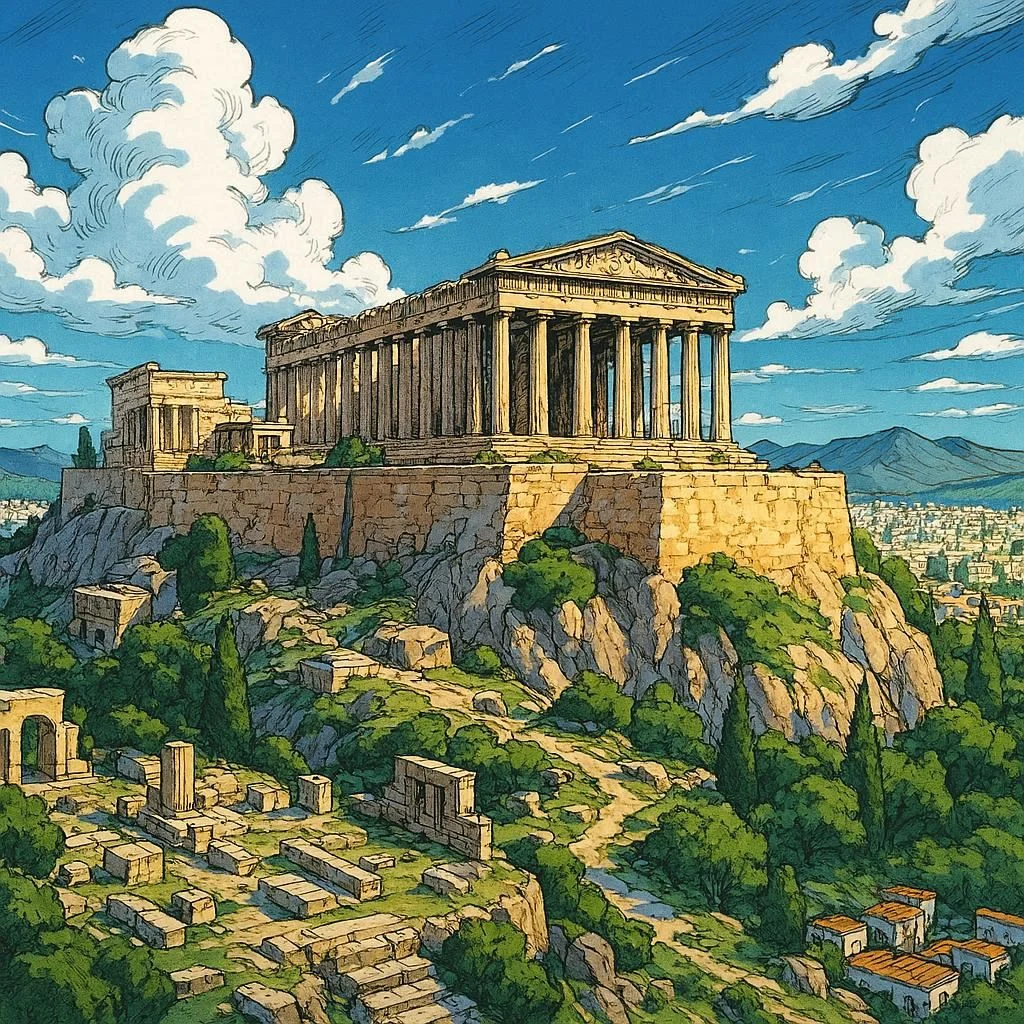
Imagine climbing a huge rock and finding up there a group of marble temples that have been watching over Athens for more than 2,400 years. That is the Acropolis: an elevated city that ended up becoming one of the most famous symbols of ancient Greece.[1]
A city on a mountain
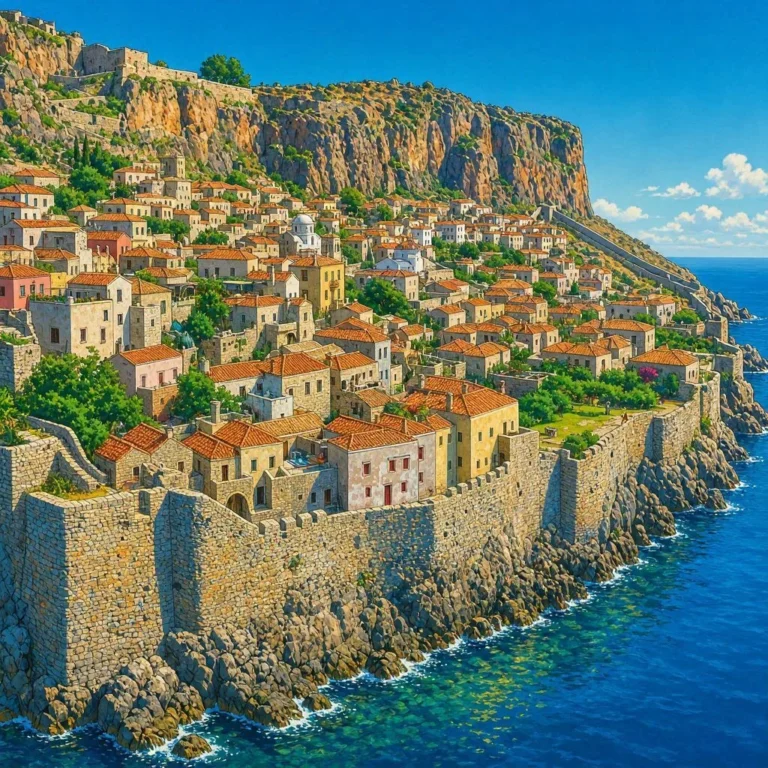
The word Acropolis means “high city”. The one in Athens rises on a rocky hill about 156 meters high and, for thousands of years, had defensive, political, and religious functions.[1]
Long before the famous Parthenon existed, the summit was already occupied. In Mycenaean times there was a residence protected by walls there. Over time, the Acropolis acquired an increasingly religious character and became the main sanctuary of Athena, the protective goddess of the city.[1]
From above, the inhabitants could observe a huge part of the Athenian plain. The rock was not only a place to build temples: it was also a strategic position.
Athena versus Poseidon
According to one of the great myths of Athens, the city needed to choose its protector. Poseidon, god of the sea, and Athena competed to become the protective divinity. Poseidon struck the rock with his trident and, according to tradition, made water appear. Athena offered an olive tree.
The inhabitants chose Athena. The olive tree thus became one of the symbols of the city. The myth explained, in an imaginative way, the special relationship between Athena and Athens.
Pericles’ great project
The Acropolis we know today took its shape mainly during the 5th century BC. After the wars against the Persians, Athens started a huge construction program politically directed by Pericles.[1]
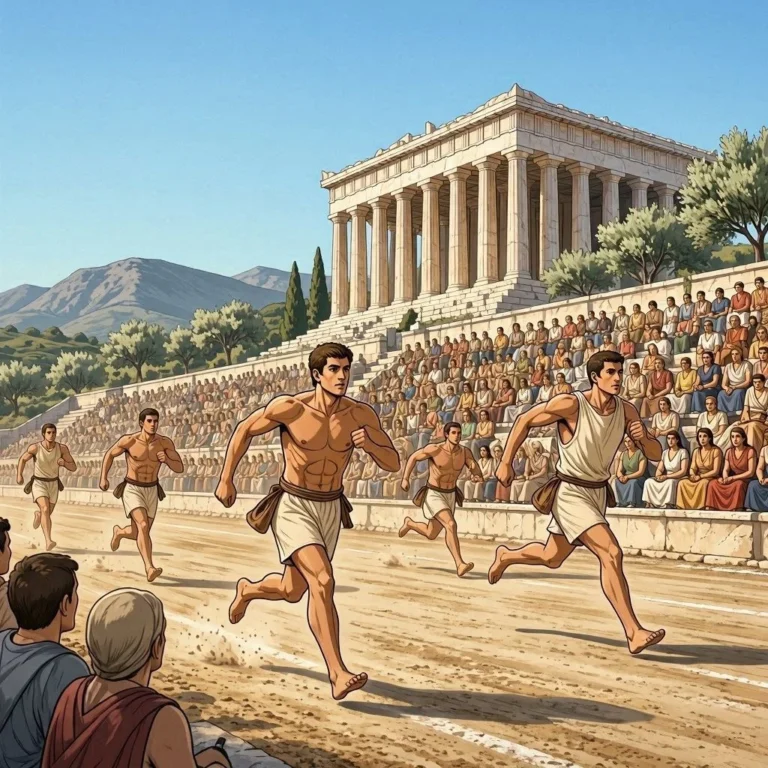
The most famous building was the Parthenon, dedicated to Athena. Its construction began in 447 BC and finished around 432 BC. The architects Ictinus and Callicrates participated in its design, while the sculptor Phidias was related to the artistic direction and decoration.[1]
It was not alone. On the Acropolis were also built the Propylaea, the monumental entrance to the complex; the temple of Athena Nike; and the Erechtheion, famous for its columns shaped like women, known as caryatids.[1] Together they formed an extraordinary architectural landscape.
A temple that looks perfect
At first glance, the Parthenon seems to be built with completely straight lines.
But its architects did something much more sophisticated. They introduced small modifications in the shapes and proportions of the building to achieve certain visual effects. The Parthenon has numerous architectural refinements that make the whole thing look balanced when observed from afar.[2]
Even some parts that look perfectly straight have slight curvatures. That means the builders did not just place huge blocks of marble one on top of the other. They studied how a person standing in front of it would see the building. Architecture could also trick the eyes a little bit.
Was it really white?
Today many people imagine the Acropolis as a set of completely white buildings. But the ancient reality was much more colorful. Greek temples received painted decoration and had elements with intense colors. The passage of centuries, the weather, and the loss of the layers of paint left the marble with the clear appearance we currently associate with classical architecture.
That is why, if you could travel back in time to 5th-century BC Athens, the Acropolis would probably surprise you: it would not look exactly like the white ruins we see today.
A gigantic construction
Erecting these buildings required a huge amount of work. The marble blocks had to be quarried, transported to Athens, and then placed with precision. The builders used tools, ramps, ropes, levers, and lifting systems. Many columns were formed by large pieces of stone placed on top of each other.
And all of that was done without modern cranes, engines, or heavy machinery. Each block represented a combination of human strength, planning, and technical knowledge.
The Acropolis survived many lives
For nearly 2,500 years, the buildings changed function. The Parthenon even became a Christian church and later a mosque. The Acropolis suffered wars, looting, fires, earthquakes, and explosions.[1]
One of the most destructive episodes occurred in 1687, during the conflict between Venetians and Ottomans. The Parthenon was being used as a gunpowder magazine when a projectile hit the building. The explosion destroyed a huge part of the temple.[1] The monument that had survived for centuries was severely damaged in a few moments.
A ruin that is still being cared for
Since 1975 there has been a comprehensive scientific program for the conservation and restoration of its monuments. Specialists study the stones, document each piece, and use modern techniques to protect what remains.[3]
Restorations are not simply about rebuilding everything as if it were new. The goal is to preserve the old parts and recover, when possible, elements of their original shape using scientific criteria.[3]
In 1987, the Acropolis of Athens was included in the UNESCO World Heritage List.[1]
Much more than a set of temples
The Acropolis represents a fundamental part of the history of classical Greece.
In the Athens of that time, philosophy, theater, the arts, and new forms of political participation flourished. UNESCO itself considers the Acropolis an extraordinary testimony of the ideas and creations that marked that civilization.[1]
That is why, when someone gazes at the Parthenon, they are not just looking at ancient columns. They are looking at a construction that has survived wars, religions, empires, earthquakes, and explosions. And perhaps that is the true wonder: a city built on a rock managed to become an idea that still stands today.
Sources:
- History, monuments, evolution, and recognition of the Acropolis of Athens by UNESCO — https://whc.unesco.org/en/list/404
- Architectural refinements of the Parthenon and characteristics of the monumental complex — https://www.culture.gov.gr/en/parthenonas/SitePages/view.aspx?iID=8
- Scientific program for the conservation and restoration of the monuments of the Acropolis — https://www.culture.gov.gr/en/service/SitePages/view.aspx?iID=2580