
Corinth Canal
The wound that took 2,000 years to open
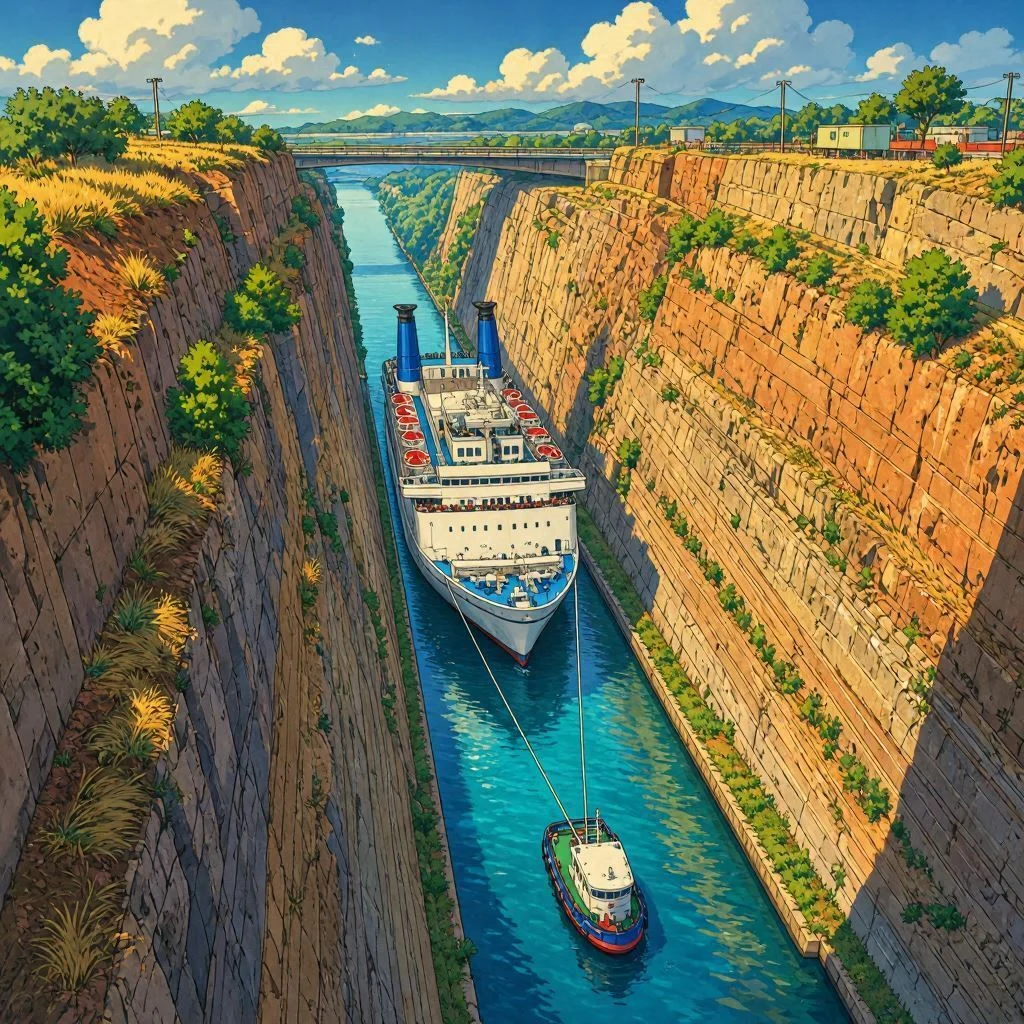
Imagine riding on a train and seeing a straight crack in the earth, with water at the bottom and a ship sailing right through that crack. It’s not a natural canyon. It’s a canal built by humans.
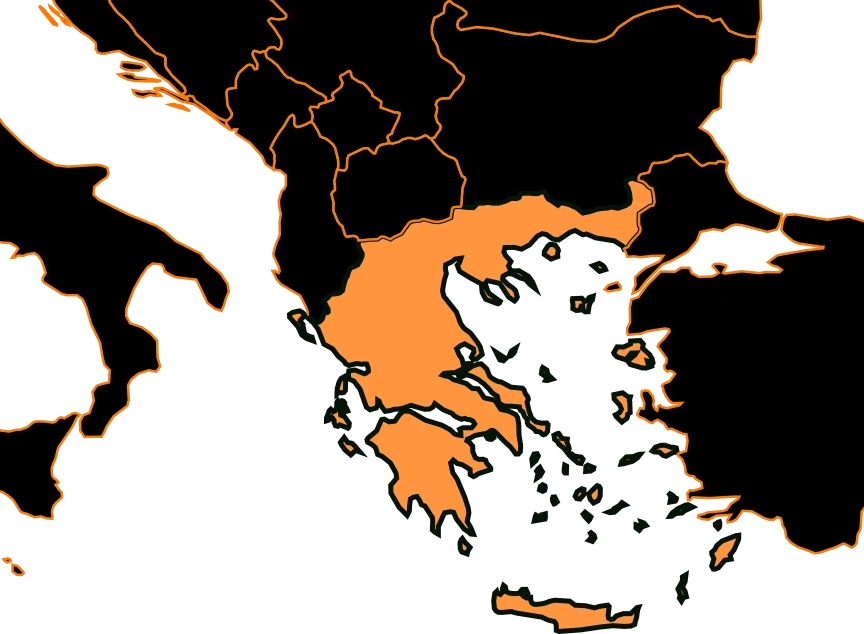
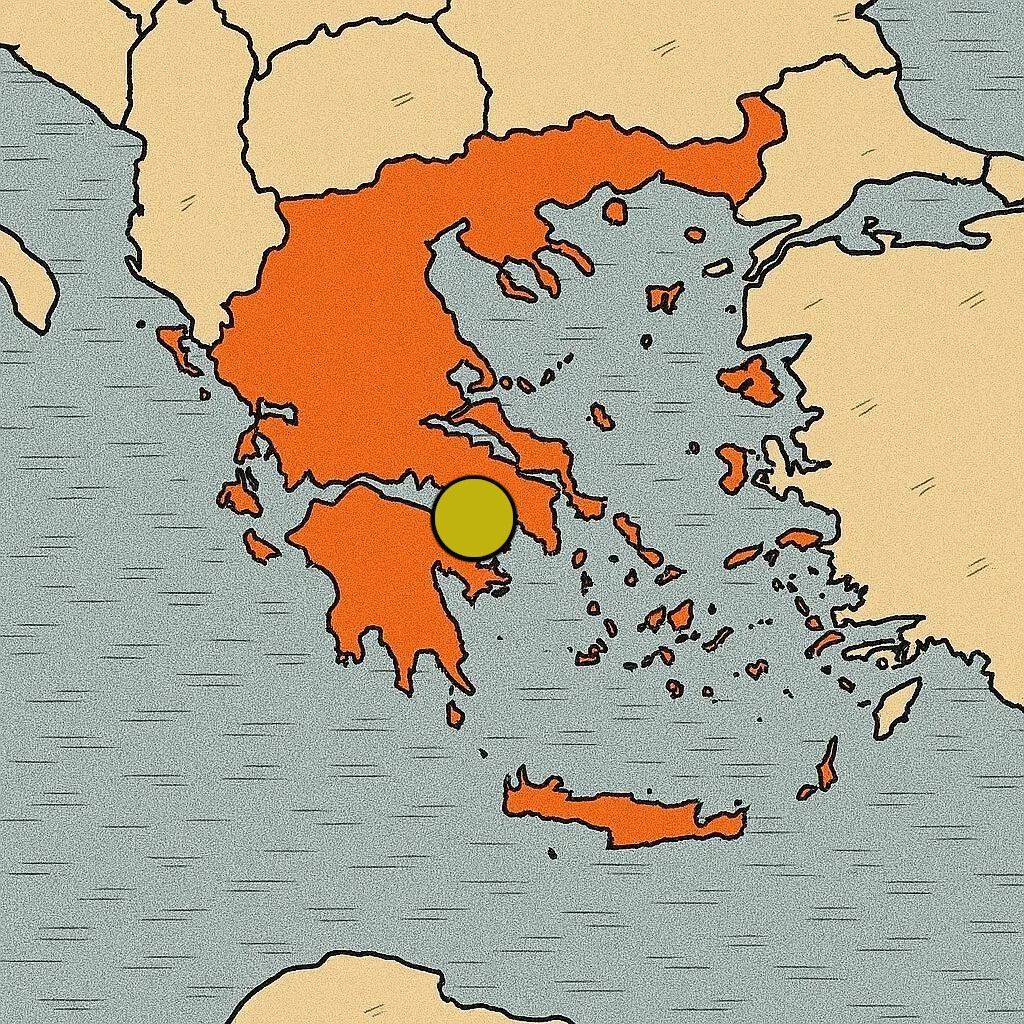
The Corinth Canal cuts across the isthmus that connects mainland Greece to the Peloponnese. It connects the Gulf of Corinth to the west with the Saronic Gulf to the east, allowing ships to avoid sailing all the way around the Peloponnese peninsula.[1]
The idea seemed simple: excavate a path for the sea. The problem was that doing so turned out to be extraordinarily difficult.
A bridge between two seas
The Isthmus of Corinth is a narrow strip of land. For centuries, ships wanting to pass between western and eastern Greece had to sail around the Peloponnese. That meant taking a much longer route and facing waters that could be dangerous.[1] The canal solved the problem by cutting straight through the isthmus.
Today it is about 6.34 kilometers long. It is approximately 24.6 meters wide at the surface and about 21 meters at the bottom. Its depth is around 8 meters.[2]
But its most spectacular feature is up top. The rock walls can rise up to about 79 meters above sea level.[2] When a ship enters the canal, it looks tiny between those huge walls.
An idea from over 2,000 years ago
The dream of opening the isthmus is much, much older than the current canal. In the late 7th century BC, the ruler of Corinth, Periander, tried to create a connection between the two gulfs. The project was never finished.[3]
Later on, other leaders also studied the possibility. Demetrius Poliorcetes tried it in the 4th century BC. The Romans thought about doing it too. Julius Caesar and Caligula were both connected to projects to cut through the isthmus.[3] But none of them managed to turn the idea into reality.
Meanwhile, the Greeks used a different solution: the diolkos, an ancient trackway that allowed ships or cargo to be transported overland across the isthmus. It wasn’t a canal, but it showed just how important it was to avoid the dangerous trip around the Peloponnese.[3]
Nero arrived with a golden shovel
In AD 67, the Roman Emperor Nero decided to try excavating again.[3] According to historical sources preserved by the canal’s management, Nero inaugurated the works with a ceremony and used a golden tool to symbolically start the digging.[3]
Thousands of workers took part in the project. Trenches were opened and a considerable part of the route was excavated. But the canal was never completed. Nero had to return to Rome because of political problems in the Empire, and after his death, the works were abandoned.[3]
For centuries, the huge scar dug by the Romans remained as a reminder of a project that seemed impossible.
The dream starts over
There were other attempts, but none succeeded in finishing the canal. Finally, in the 19th century, the idea gained strength once again. After the opening of the Suez Canal in 1869, the construction of large maritime canals showed that projects of extraordinary dimensions could become reality.[4]
The excavation of the isthmus was then promoted in Greece. Modern works began in 1882. Engineers from different countries took part in the project, including the Hungarian Béla Gerster, who was in charge of studying the route.[4]
New engineering techniques and explosives like dynamite were used. Even so, the project suffered financial problems and work was stopped for a time. Eventually, it continued under a new company.
In 1893, the sea cut through the land
After about eleven years of work, the canal was inaugurated on July 25, 1893.[4] The idea that had been born more than two millennia earlier had finally become a reality. The inauguration was a huge event for the Greece of that era. The isthmus had been opened. Two seas were now connected by a narrow artificial waterway.
It was proof of something Periander and Nero had already imagined many centuries before: engineering could change the geography that ships encountered.
The earth can close it up again too
Building the canal was difficult. Keeping it open has been too. The geological characteristics of its walls have caused earth and rock landslides. In 1923, for example, a huge landslide of about 41,000 cubic meters kept the canal closed for two years.[2]
In 1944, during the German retreat from Greece in World War II, explosions caused further damage and about 60,000 cubic meters of landslides.[2] Repairs took several years.
The canal’s history thus shows that excavating a mountain doesn’t mean the mountain has stopped moving.
A canal that is still alive
The Corinth Canal continues to be used for maritime traffic and tourism. According to information from the canal company itself, it receives thousands of transits each year, including commercial ships, cruise ships, tour boats, and yachts.[5]
It also has two submersible bridges, located at its ends in Isthmia and Poseidonia. When a ship needs to pass, the bridge sinks underwater and allows navigation to continue.[1] It’s a curious sight: a road disappears underwater to let a ship pass by.
In 2026, after major restoration and slope stabilization work, the canal reopened to navigation on June 17.[6]
World champion of perseverance
The Corinth Canal could hold a special title: World Champion of Perseverance, since the idea of building it took more than 2,000 years to become a reality. There were many attempts to create it, by Periander or the Roman Emperor Nero, for example. But the rock won.
For centuries, the dream was abandoned. Finally, in the 19th century, modern works began in 1882 and, after enormous difficulties, the canal was inaugurated in 1893.[2] That means more than twenty centuries passed between the first major attempts and the opening of the canal.
Few works can tell such a story: an idea imagined in antiquity, abandoned for generations, and finally built when technology made it possible to achieve what for centuries seemed impossible. The Corinth Canal didn’t just cut a mountain: it also crossed more than 2,000 years of history.
Sources:
- Characteristics of the canal, connection between the two gulfs, dimensions, submersible bridges, and navigation — https://www.visitgreece.gr/en/experiences/nature/volcanoes/corinth-canal
- Dimensions of the canal, wall height, landslides, and historical closures — https://corinthcanal.com/the-canal/specifications/
- History of the projects by Periander, Demetrius Poliorcetes, the Roman emperors, and Nero — https://corinthcanal.com/the-canal/the-history-of-the-canal/
- History of modern construction, works started in 1882, and the 1893 inauguration — https://corinthcanal.com/wp-content/uploads/2026/04/AEDIK-EN-31-1-26.pdf
- Commercial and tourist transits and current activity of the Corinth Canal — https://corinthcanal.com/wp-content/uploads/2026/04/AEDIK-EN-31-1-26.pdf
- Reopening of the Corinth Canal to navigation on June 17, 2026, following restoration work — https://corinthcanal.com/corinth-canal-reopening-dear-partners/