
Mount Athos
The forbidden peninsula
Imagine a Greek peninsula where forests cover the mountains, twenty monasteries look like fortresses, and a community of monks maintains a way of life that feels closer to a thousand years ago than to the present day. That place actually exists. It is called Mount Athos.
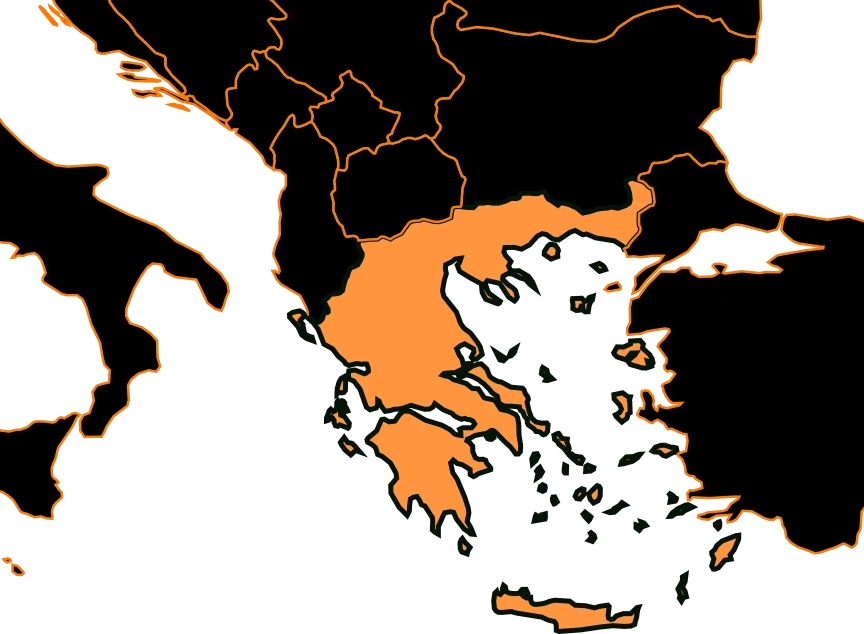
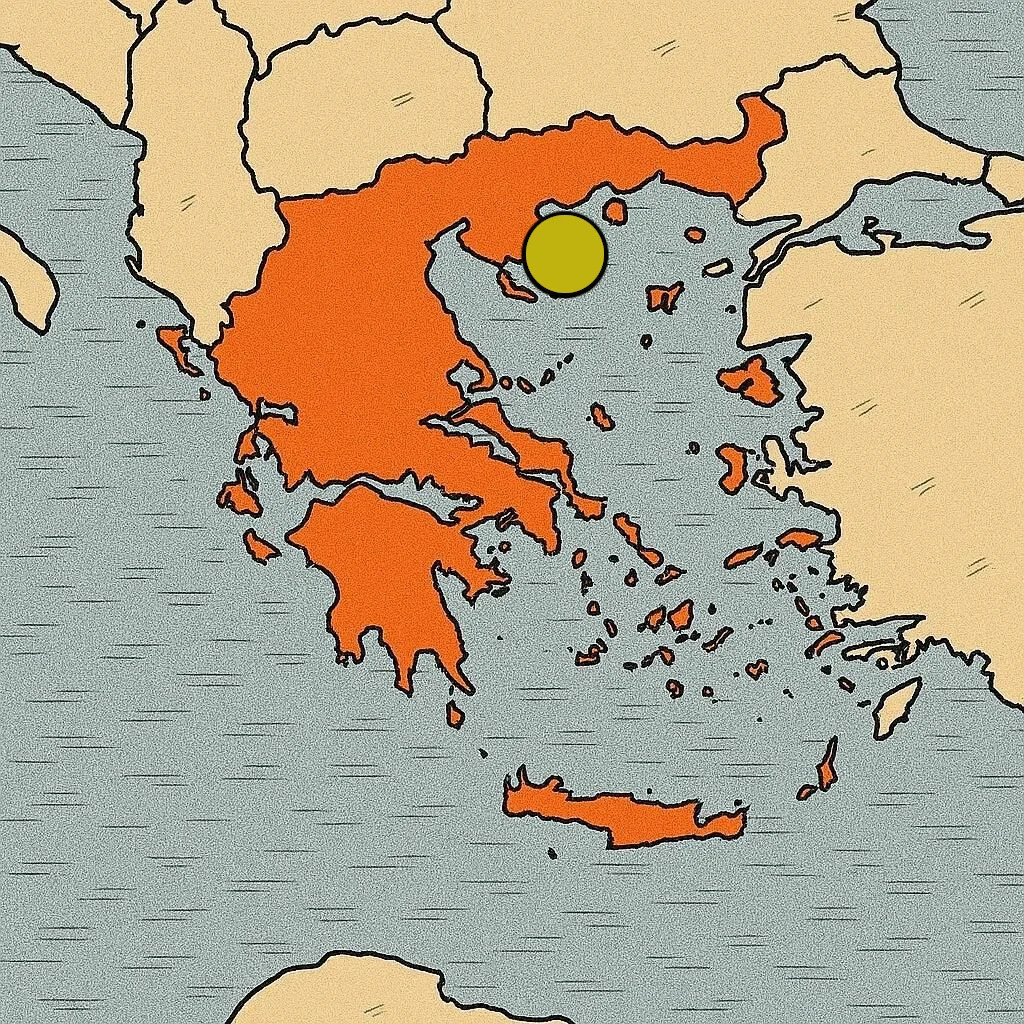
It is located in northern Greece, on the easternmost peninsula of Chalcidice, jutting out into the Aegean Sea. It is not an independent country: sovereignty belongs to Greece, but Mount Athos has a special self-administration regime within the Greek state.[1] To enter, you need to get a special permit. And there is an even more surprising rule: women and young children are not allowed to enter the peninsula.[1]
A mountain turned into a world
Mount Athos is not just a mountain. The entire peninsula forms a monastic territory of over 33,000 hectares, largely covered by Mediterranean forests. Among the slopes, you can find monasteries, small communities, hermitages, orchards, and paths.[1]
Its main mountain reaches about 2,033 meters in height and ends in a spectacular rocky peak rising above the Aegean.
For centuries, monks have lived here seeking one very specific thing: to get away from the noise of the world to dedicate their lives to prayer. The monastic tradition became especially well-established starting in the 10th century. In 963, Saint Athanasios of Athos founded the Great Lavra, considered the oldest still-operating monastery.[2] A few years later, in 972, Byzantine Emperor John I Tzimiskes formally recognized the organization and rules of the monastic community.[1]
Monasteries that look like fortresses
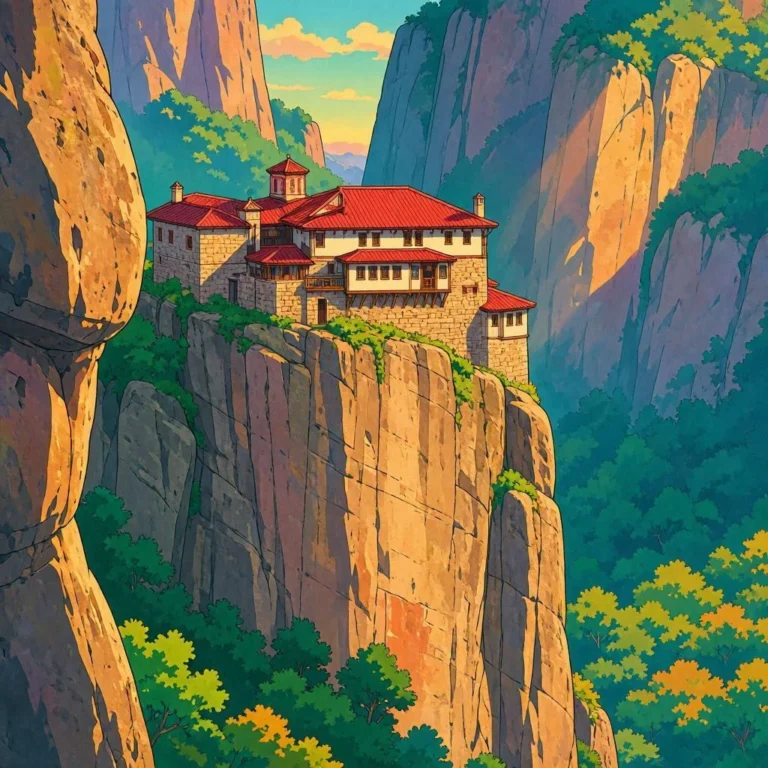
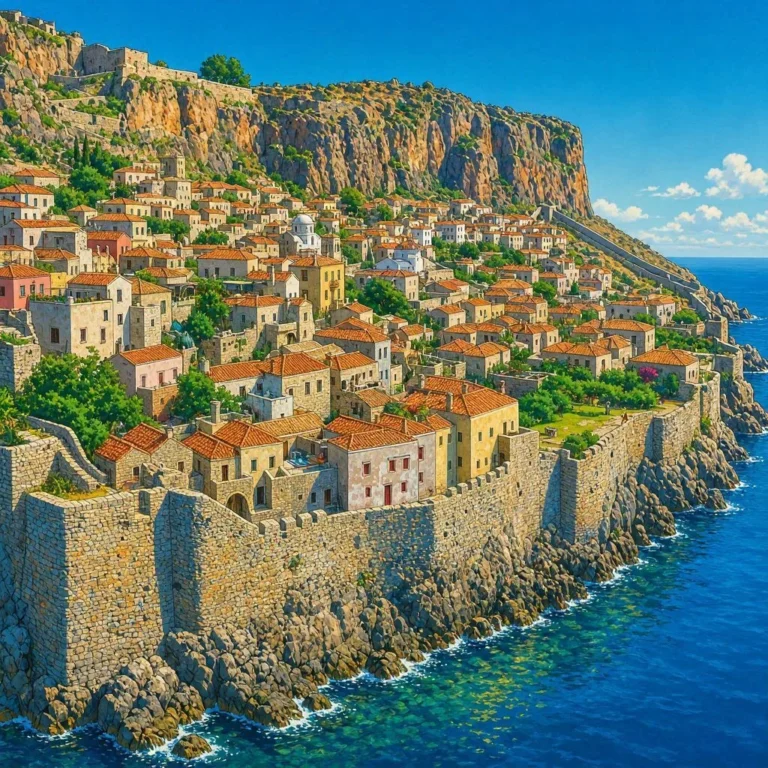
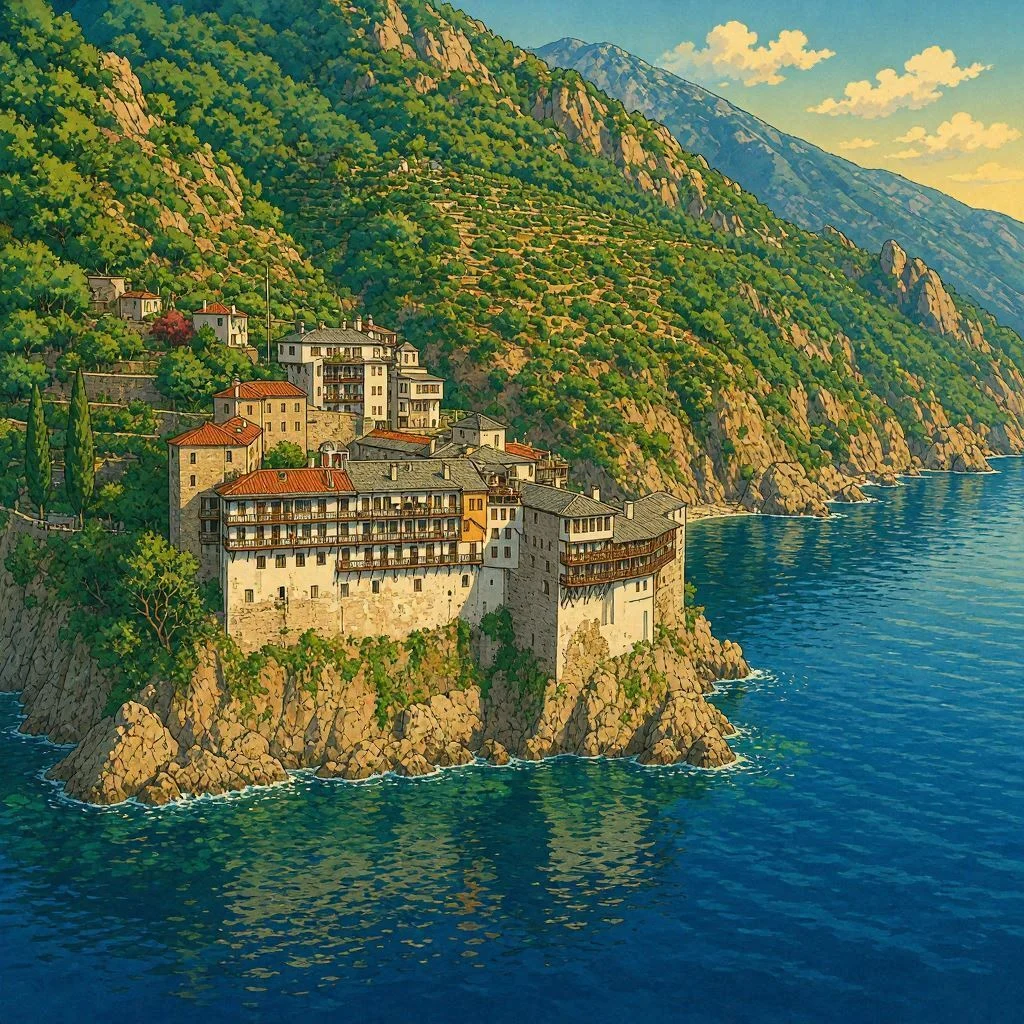
When you picture a monastery, you might think of a peaceful building surrounded by gardens. In Athos, some look like true medieval fortresses. The monasteries are surrounded by huge walls and towers. In the center, you will usually find the main church, called the katholikon. Around it are the monks’ cells, dining halls, libraries, chapels, storehouses, and other spaces needed for daily life.[1]
This architecture had a practical reason. During the Middle Ages, monasteries needed to protect themselves from attacks and looting. Their thick walls and towers could turn them into small fortified refuges.
From a distance, some look like castles built upon the mountain. But behind their walls lay another world: churches covered in paintings, manuscripts, icons, and spaces dedicated to prayer.
Monks in caves
Long before large monasteries existed, there were men who sought even more isolated places. They ventured into the mountains, lived in small hermitages, and, in some cases, occupied natural caves. This was the hermit tradition, based on a life of solitude, silence, and prayer. Over the centuries, these ways of life coexisted with the large monasteries, and this is seen most intensely in Athos.
That is why Athos is not just a single city of monks. It is a network of monasteries, hermitages, small communities, and cave dwellings spread across a mountainous peninsula.[1]
Twenty monasteries
Currently, there are 20 main monasteries on Mount Athos, and UNESCO notes that they are inhabited by around 1,400 monks.[1] Among them are the Great Lavra, Vatopedi, Iviron, Dionysiou, Simonopetra, and other monasteries linked to different traditions of the Orthodox world.
Not all of them share the same history. Some are mainly related to the Greek tradition, while others maintain historical ties with Serbian, Bulgarian, Romanian, or Russian communities.[1] Thus, a small Greek peninsula ended up becoming a meeting place for different peoples of Orthodox Christianity.
A living museum of art
Inside the monasteries, an extraordinary artistic heritage is preserved. There are frescoes, icons, illuminated manuscripts, embroidery, gold and silver objects, and ancient books.[1]
Some paintings are centuries old. Artists depicted Bible scenes, saints, and episodes from Christian tradition. Over time, the artistic school developed in Athos had an enormous influence on Orthodox religious art, even far beyond Greece.[1] The influence reached all the way to Russia and the Balkans.
Because of this, stepping into one of these monasteries is like opening a door to a library and a museum that are still very much alive.
A beacon of Orthodoxy
Mount Athos became an important Orthodox spiritual center starting in the 10th century and took on a fundamental role in the Orthodox world from 1054 onwards, a date traditionally associated with the schism between the Churches of East and West.[1] After the fall of Constantinople in 1453, Athos kept its importance.
Empires changed. Maps changed. Borders changed. But the monasteries kept operating. For centuries they welcomed monks, pilgrims, manuscripts, works of art, and traditions from different Orthodox regions. This is why UNESCO considers Athos a spiritual center whose influence spread across numerous countries.[1]
A territory that is not a country
This is where one of the most curious features comes in. Mount Athos is not an independent country. The Greek Constitution recognizes its special status and maintains the sovereignty of the Greek state. At the same time, internal administration belongs to the community of monasteries, represented by the Holy Community.[1]
In other words, it belongs to Greece, but it operates in a very unique way. Its current system preserves institutions and rules rooted in the Byzantine era. It is a combination that is hard to find: a territory integrated into a modern state that maintains a monastic organization with over a thousand years of history.
The forbidden peninsula
Entry to Athos is strictly regulated. Men who wish to visit need a special permit, known as a diamonitirion, and the number of visitors is limited.[3] Women and young children are forbidden from entering according to the traditional rules of the territory.[1]
This rule has sparked debates and controversies, especially regarding equality and access to cultural heritage. However, it is part of the special monastic regime that the Greek authorities recognize for Athos.
That is why its nickname as the “forbidden peninsula” is not a literary exaggeration: for millions of people, access is truly closed.
A tradition that is still alive
In 1988, Mount Athos was inscribed by UNESCO as a World Heritage Site, both for its cultural and spiritual importance and for its natural landscape.[1]
And that is important: Athos is not simply a collection of old buildings. The monasteries are still inhabited. Monks continue to pray, farm the land, restore works of art, copy or preserve manuscripts, and maintain traditions that have survived for centuries.[1]
The landscape is also part of that history. Forests and agricultural lands have been cared for across generations through traditional practices. It is as if a fragment of the Middle Ages managed to keep living inside the modern world.
An impossible city… community
Although Mount Athos is not a city in the usual sense, it fits into the Impossible City series for an extraordinary reason: it is a monastic territory where daily life follows rules very different from those of any modern city. These rules have helped preserve an exceptional natural landscape, walled monasteries maintained with hard work and dedication, paths, orchards, and small communities that still use traditional techniques.
It is a place practically impossible to replicate today: it would take generations to recover a way of life that has been evolving here for over a thousand years.
Sources:
- History, self-administration regime, monasteries, monks, art, landscape, and access restrictions of Mount Athos — https://whc.unesco.org/en/list/454
- History of the Great Lavra and the origins of organized monasticism in Athos — https://www.britannica.com/place/Mount-Athos
- Information about the entry permit and visiting conditions for Mount Athos — https://www.visitgreece.gr/experiences/religious-tourism/mount-athos/